



Relation to UL
UL stands for Underwriters Laboratories, an independent organization that provides testing and certification services for products such as machinery and control cabinets and, for this purpose, develops appropriate standards and testing procedures for the North American market. Many of UL’s more than 1,300 safety standards have already been adopted as American National Standards. In addition to components and products, UL also certifies manufacturers, who, upon passing the certification process, are permitted to affix the UL label to their products themselves.
What does the abbreviation UL stand for?
UL stands for Underwriters Laboratories, which roughly translates to “insurance companies’ testing laboratories.” It is an independent, private-sector organization that tests and certifies products for the North American market to ensure their safety.
The Origins of UL
UL traces its origins to 1893. William Henry Merrill, a graduate of the electrical engineering program at the Massachusetts Institute of Technology (MIT), was sent from Boston to Chicago to assess fire risks for his insurance company in connection with the construction of the World’s Fair. As an electrical inspector at the World’s Fair in Chicago, Merrill presented his idea of establishing a testing laboratory for electrical safety to the insurance representatives he met while on the job.
The Chicago Underwriters Association and the Western Insurance Union provided funding to support Merrill’s vision. In the years leading up to this, their expenses had risen sharply due to claims for fire damage caused by improperly installed electrical systems. In doing so, they paved the way for the founding of the Underwriters Electrical Bureau, which evolved into today’s globally active organization, Underwriters Laboratories.
UL is growing and expanding its offerings
By the age of 25, Merrill had already recognized that the field of product safety held great potential and that the testing of electrical products was a key aspect of this field. In the years that followed, the organization grew steadily. It developed standards, conducted tests, designed the necessary equipment, and identified potential hazards. Over the years, the range of products tested has also expanded significantly and today encompasses virtually every conceivable product, from consumer electronics to industrial equipment to software.
UL in Germany
Underwriters Laboratories is currently headquartered in Northbrook, Illinois. However, a German company does not need to travel to the United States to have a product tested by UL. The German branch of the organization, UL Solutions Deutschland (formerly UL International Germany GmbH), is based in Neu-Isenburg near Frankfurt, which is also home to the European headquarters. In addition, UL has offices in 13 other German cities.

UL’s Responsibilities
UL develops standards and procedures for the North American market that enable the institute to test products, components, materials, systems, and equipment itself. To date, UL has developed more than 1,300 safety standards. Many of these have since been adopted as American National Standards (ANSI).
In addition to developing standards and specifications, Underwriter Laboratories also tests and certifies products itself. If the tested items or systems meet the required standards, they receive certification in the form of a UL mark—also known as a UL label or UL certification mark —which remains valid as long as the standards are maintained.
The Role of UL in Workplace Safety
UL is one of the federally recognized testing laboratories in the United States and is therefore listed on the Occupational Safety and Health Administration’s (OSHA) list of Nationally Recognized Testing Laboratories (NRTL). This U.S. federal agency is responsible for ensuring workplace safety by establishing and enforcing occupational safety regulations and standards. However, UL and the other NRTLs do not test according to OSHA standards, but rather according to standards they have developed themselves, which, however, meet at least the legal requirements. This is a prerequisite for a private testing laboratory to be recognized as an NRTL.
UL Certifications
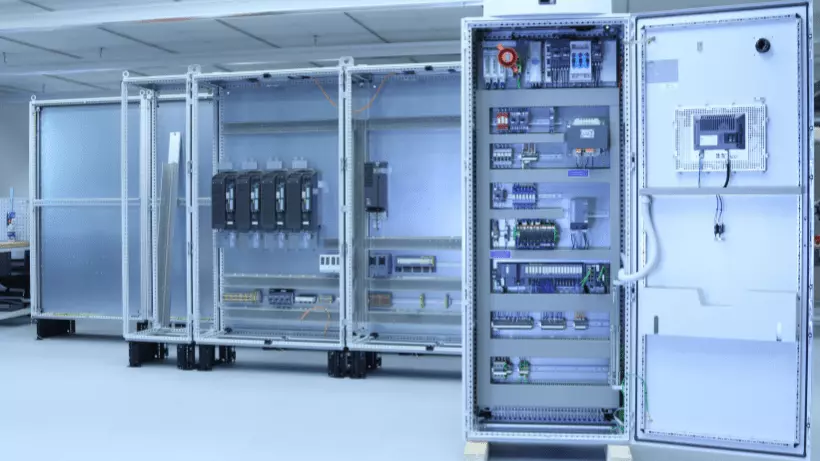
UL offers several types of certification: The specific UL certification required depends primarily on the type of product to be tested—a component, a finished product for the end customer, or an entire system. The specific requirements for the test object are defined by the applicable UL standard. For example, an industrial control cabinet is tested according to UL 508A and, if it meets those requirements, receives a UL Listing Label, since it is a finished product intended for the end customer. The following UL marks are particularly important:
- UL Listing: Representative samples of a product are tested here . If the testing determines that they meet UL’s applicable safety requirements, they are awarded the UL Mark UL Listed. This testing always applies to a standalone product with a specific function. When people mistakenly refer to “UL approval” in everyday language, they are actually always referring to this type of UL certification
- UL Recognized: This certification does not apply to complete products, but exclusively to components or materials intended for use in a product or system. If the component bears the UL mark UL Recognized Component, it may be used in a product or system that already bears the UL Listed label. In this case, the entire product does not need to be tested again. However, assembly must not be performed by the end customer but only by a UL-certified manufacturer, as the necessary safety is only fully ensured through proper installation.
- UL Classified: Products bearing this classification mark have been testedand evaluated only for very specific characteristics, such as with regard to a predefined hazard area, to eliminate certain risks, or for use under specific conditions, such as on the high seas. These UL-classified products are just as safe as products bearing the UL Listed mark, with the restriction that they may only be usedin specific areas or situations.
- Functional Safety: The UL Mark for functional safety is awarded to all products that have been tested in accordance with both the requirements of the UL Listed Mark and those for functional safety. This refers to the correct functioning of safety-related control systems and software. This mark is not awarded very often, as it is limited to products used in applications requiring functional safety.
On-site Inspections/Field Inspections
The Field Inspection Mark is awarded to products that have been tested directly at the point of use, rather than in UL’s testing laboratories or at the manufacturer’s production facility. If a product does not bear a mark of approval or has been substantially modified since manufacture, the building owner, the relevant regulatory authority, or any other person involved with the product may request that UL test the product directly at the point of use.
A field inspection can, of course, quickly present German manufacturers with problems. If the inspectors identify major issues, these must either be resolved on-site or the entire machine or system must be shipped back to Germany for overhaul. In this situation, it is a major advantage for a German company to have competent and reliable American partners who can take on this task.

How important is a UL certification?
Even though manufacturers are under no legal obligation to have their products certified by UL, in practice the UL mark is often an important prerequisite for accessing the North American market. In the U.S., UL is the best-known NRTL, so many state inspectors rely on the UL mark when approving industrial equipment. This approval, in turn, is a prerequisite for the equipment to be put into operation.
What is the situation like in Canada?
Canada has the CSA Group (formerly the Canadian Standards Association), a semi-governmental testing organization comparable to UL, which is also represented in the U.S. market through its subsidiary , CSA Group Testing and Certification Inc. Conversely, UL also operates in the Canadian market through UL Solutions of Canada. However, it is not necessary to obtain a label from both organizations for the respective country, as UL and the CSA Group recognize each other’s certifications.
Relation to UL – UL Classified
Components on the machine or in the control cabinet that bear a classification label (UL Classified Label) may only be used in specific areas or situations, as they have been tested only for certain characteristics.
Relation to UL – UL Recognized
In a UL-compliant machine and its control cabinet, it is generally necessary to use UL-compliant components as well. The UL Recognized Label does not apply to complete products, but only to subcomponents or materials. This allows them to be used in a UL-listedproduct without requiring the product to be retested.
Zusammenfassung
Underwriters Laboratories, or UL for short, is an independent organization that develops safety standards and tests and certifies products against those standards. The organization traces its origins to Henry Merrill, who, in 1893, was working as an electrical inspector for an insurance company and was tasked with assessing fire risks at the World’s Columbian Exposition in Chicago. He proposed establishing an electrical testing laboratory to ensure greater safety in the use of electrical products. To date, UL has developed over 1,300 safety standards, many of which have been adopted as American National Standards (ANSI).
As an OSHA-certified testing laboratory, UL tests and certifies components and products manufactured in accordance with the organization’s own standards. The most important UL certifications include the UL Listing mark, which applies to standalone products; the UL Recognized mark, under which only components and materials are tested; and the UL Classified mark, for products with specific characteristics and a defined hazard category.

