



Relation to UL
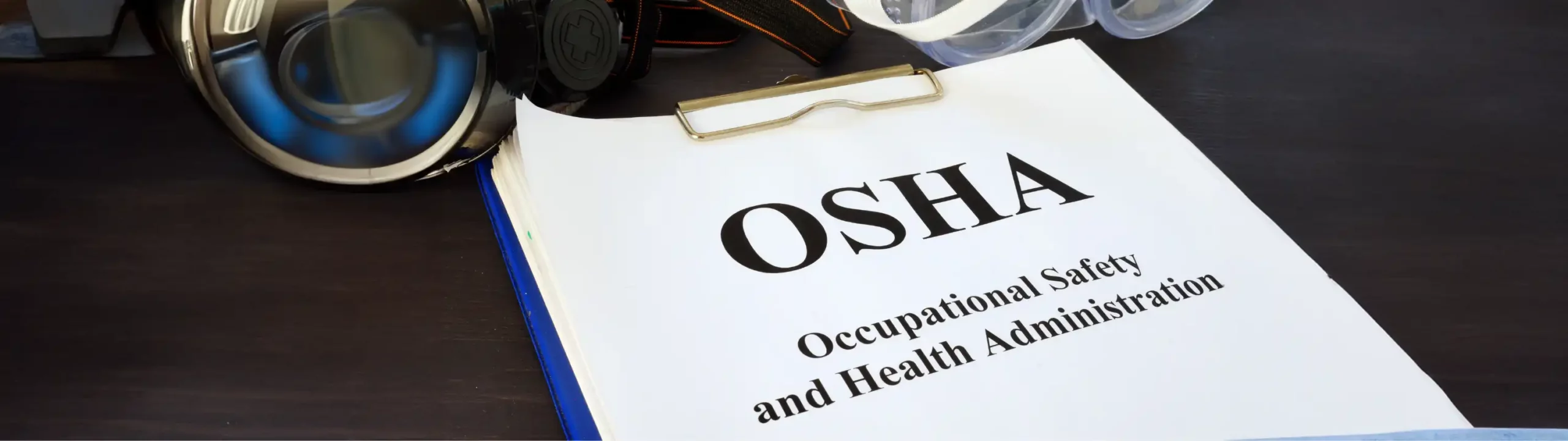
OSHA, the U.S. Occupational Safety and Health Administration, is responsible for establishing standards and regulations. Among other things, it sets the legal framework for machinery and control cabinets and, in this context, is also responsible for all UL testing and certification.
What does OSHA stand for?
The Occupational Safety and Health Administration, or OSHA for short, is the U.S. agency responsible for ensuring health and safety in the workplace.

OSHA’s Mission and Role
OSHA was established in 1971 to enforce the OSH Act (Occupational Safety and Health Act), the U.S. federal occupational safety and health law, which took effect at that time. OSHA’s mission is to ensure that employers comply with applicable workplace safety standards to protect the health and safety of workers and prevent workplace accidents. To this end, it establishes and enforces standards. Employers are required to comply with all applicable OSHA standards. They must also comply with the “General Duty Clause” of the OSH Act, which requires employers to keep their workplaces free of serious, recognized hazards.
In the event of a workplace accident involving a machine or workstation, OSHA inspectors investigate and evaluate the incident. If it is determined that applicable standards were not followed, OSHA may impose heavy fines.
OSHA Standards for UL Testing
Among other things, OSHA is also responsible for all UL tests and UL certifications. For machine manufacturers in the EU who wish to export their machines and equipment to North America, Title 29 of the Code of Federal Regulations (CFR) 1910 Occupational Safety and Health Standards is particularly important. This is because that section, as well as Sections 90.7, 110.2, and 110.3 of the NEC (National Electrical Code), governs the approval of electrically controlled devices and systems. Section 29 of CFR 1910 specifies the applicable standards in the area of occupational safety.

EN and IEC Standards vs. UL Standards
To export products to the North American market, European testing based on EN or IEC standards is not sufficient. Compliance with national regulations such as UL, CSA, and ANSI testing standards is mandatory. For OSHA, products are considered safe only if they have been approved by a government-recognized testing laboratory, an “NRTL” (Nationally Recognized Testing Laboratory), and have been marked by that laboratory with one of the applicable certification marks, such as the UL mark. For example, UL 2011 is a standard that applies to industrial machinery and equipment in the United States. It is intended to ensure that machinery and equipment meet the fire safety requirements specified by OSHA. There are currently 19 NRTLs worldwide. OSHA accredits the testing laboratories and regularly publishes lists of these testing bodies.
A Comparison of EU Directives and OSHA Standards
Testing in accordance with UL standards is intended to protect users. The presence of the certification mark is regularly checked—for example, during unannounced workplace inspections conducted by OSHA. When comparing the IEC (International Electrotechnical Commission) standards and the European standards (EN) with the OSHA standards, the OSHA standards are significantly more specific in terms of technical requirements than the corresponding European standards. Another major difference lies in the intended audience for the standards: while OSHA standards are intended for employers who operate machinery and equipment, EU directives are primarily aimed at the manufacturers and integrators of such machinery and equipment.
Comparison Between OSHA and EU-OSHA
The European Agency for Safety and Health at Work, or EU-OSHA for short, has similar goals to those of the U.S. Occupational Safety and Health Administration (OSHA). Both institutions work to improve the safety and health of workers—though their approaches differ. While the U.S. OSHA is primarily responsible for enforcing occupational safety and health laws and inspecting workplaces, EU-OSHA focuses more on research, information, and prevention. Another key difference is that EU-OSHA does not play a regulatory or punitive role; instead, it relies on cooperation and knowledge sharing to support businesses in the EU.
History of the Occupational Safety and Health Administration
Since 1934, the “Bureau of Labor Standards” within the Department of Labor in the United States had been addressing workplace safety issues. After World War II, new, powerful labor unions advocated for greater workplace safety. When workplace injury rates rose again in the 1960s due to economic expansion, political pressure increased, and on April 28, 1971, the date the Occupational Safety and Health Act took effect, Congress established the Occupational Safety and Health Administration (OSHA). The new agency assumed a large part of the responsibilities previously held by the Bureau of Labor Standards.
Training and Scholarship Program
Over the years, OSHA has implemented numerous training, compliance assistance, and health and safety recognition programs. In 1972, the OSHA Training Institute was launched to train health and safety personnel in both the government and private sectors. In 1978, the Susan Harwood Training Grant Program was added, which trains workers and employers on how to reduce workplace hazards. In 1982, the Voluntary Protection Programs began, allowing employers to apply to be designated as “model workplaces” if they meet certain requirements.
Zusammenfassung
As the agency responsible for occupational safety and health, the Occupational Safety and Health Administration (OSHA) establishes standards and regulations that, among other things, serve as the legal basis for electrical systems. It is also responsible for all UL testing and certification. OSHA standards for occupational safety and health in the United States are set forth in Title 29 of the Code of Federal Regulations (CFR) Part 1910 and specifically govern the safety requirements for electrically powered machinery and equipment. In order for products, machines, and systems to be put into service in the United States, they must comply with the applicable requirements and standards. A product’s compliance with these requirements can be demonstrated through appropriate certification by a recognized testing laboratory. Testing laboratories are accredited by OSHA itself, which regularly publishes lists of accredited testing facilities. In the event of workplace accidents, OSHA inspectors assess the incident and may impose heavy fines if necessary.

