




UL standards are product safety standards for the U.S. market developed by Underwriters Laboratories (UL). Products that comply with these standards may receive a label, after passing testing, indicating their UL certification . The UL label is essential for the sale of a wide range of products in the United States.
Are UL standards government standards?
No, UL is primarily a government-recognized but purely private company that offers product testing services (Nationally Recognized Testing Laboratory, NRTL) and bases these tests on standards it has developed itself. Accordingly, UL standards are not government standards issued by U.S. agencies such as OSHA. Nevertheless, there is a close connection between UL standards and government functions.
UL standards are, of course, designed so that their requirements also encompass compliance with statutory minimum product safety requirements. However, there are also influences in the opposite direction. For example, the National Electrical Code (NEC) refers to UL standards in numerous places, and the American National Standards Institute (ANSI) has adopted many UL standards directly as national standards (the American equivalent of our DIN). Through these indirect channels, many UL standards do, in fact, attain official status.
UL standards exist for many fields
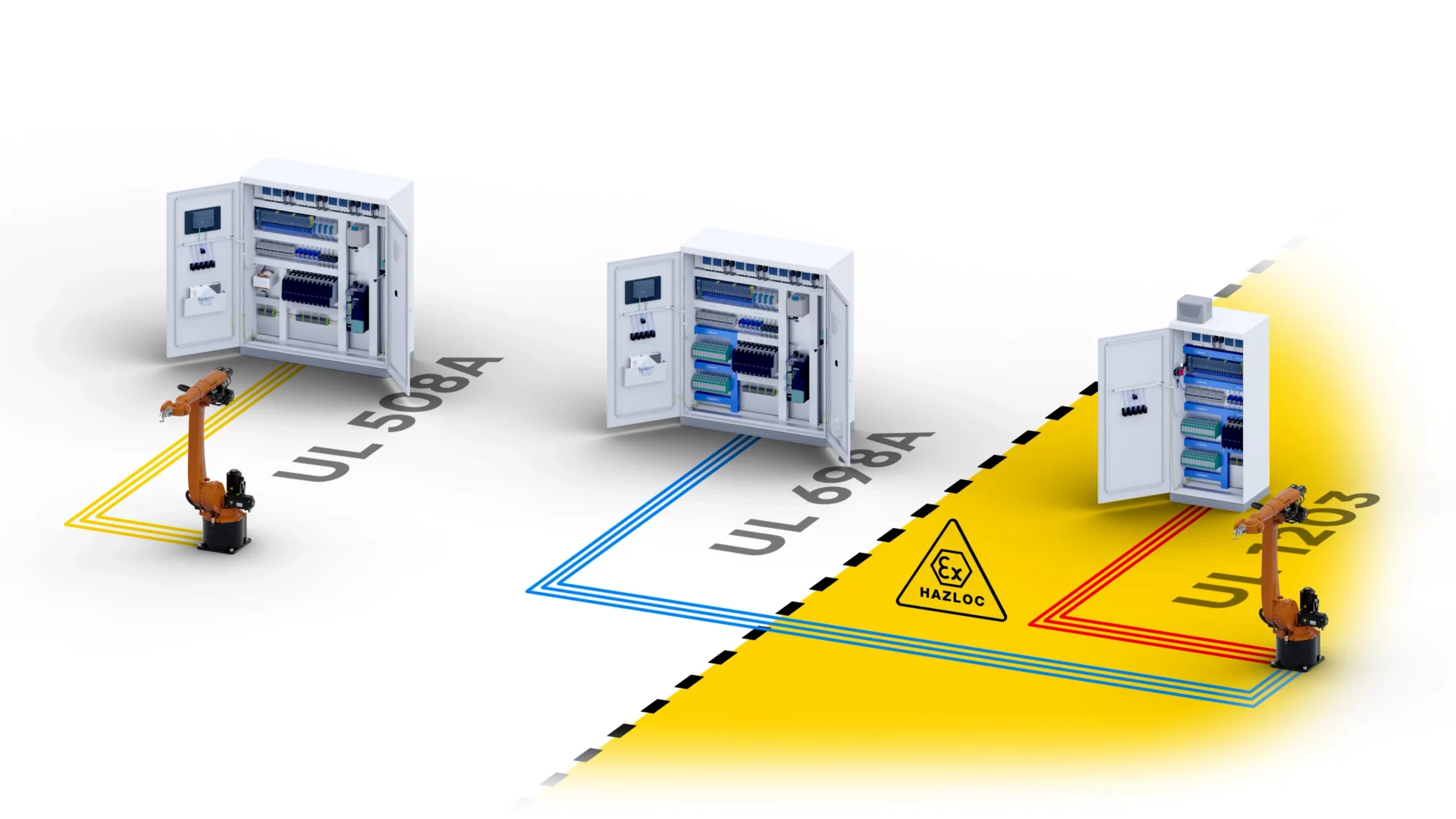
Over the course of its history, UL has developed more than 1,300 standards for product safety across numerous sectors. From the very beginning, a primary focus has been on fire safety; however, electrical and mechanical safety are just as important today. Some UL standards apply only to devices for residential use, others only to industrial equipment, and still others apply to multiple sectors. Today, the range of UL standards extends from electrical kitchen appliances (UL 1026) to requirements for control panels in industrial facilities (UL 508A).
UL Standards in Control Panel Construction
As a manufacturer of UL-certified control cabinets for the North American market, our top priority here at Krayer is the UL 508A is of particular importance. This UL standard specifies the requirements for control cabinets used in industrial facilities with regard to fire protection and protection against electrical hazards. If the control cabinet is also to be used in a potentially explosive area , the UL 1203, which sets forth specific requirements for control cabinets in these particular areas. Krayer is certified for both UL standards, which means that our control cabinets comply with these standards and are certified directly by Krayer.
Why are UL standards important for the North American market?
As mentioned, many UL standards are, in effect, part of legally binding safety regulations and must be complied with in all cases. But does compliance with these regulations have to be confirmed by UL certification? Theoretically, of course, there is no obligation to do so, since UL is a private service provider; however, in practice, it is very difficult to sell products in the U.S. without UL certification. Many wholesalers simply refuse to include products in their inventory that do not bear a UL mark. Local authorities may deny an industrial facility an operating permit if it does not bear a UL label. In addition, U.S. insurance companies often require their customers to use UL-certified products and components.
Do UL standards also apply to Canada and Europe?
Strictly speaking, UL standards apply only to the United States. Canada has its own testing organization, the CSA. However, the two institutions cooperate closely and have entered into an agreement on the mutual recognition of their respective certification marks. No such agreement exists with European standards organizations, but in recent years there have been increased efforts to harmonize standards internationally.

How is compliance with UL standards verified?
To ensure that a product complies with a specific UL standard, there are generally two different procedures. For products and components, verification is based on comprehensive testing, followed by periodic spot checks. Products that meet the relevant UL standard are permitted to bear the corresponding UL Listing Mark . This marking is referred to as UL certification; components, on the other hand, generally receive only the UL Recognized label.
For industrial systems and machinery, however, a different testing procedure is used. In these cases, compliance with safety requirements is often verified on-site first, after which afield inspection label is issued. Although all components of the system can be inspected by a UL testing engineer as part of this process, the process is significantly simplified if at least the system’s control cabinet already has certification according to the relevant UL standard, since approximately 70 percent of the total testing effort is accounted for by this part of the system.
In a nutshell: UL Standards
UL standards are not government regulations, but rather UL’s requirements for product safety in a specific area. Compliance with the respective standard can be certified by UL and indicated on the product with a corresponding label. Products without a UL label are difficult to sell in the United States. The same applies to Canada, where similar standards are in effect and UL labels are recognized.


