



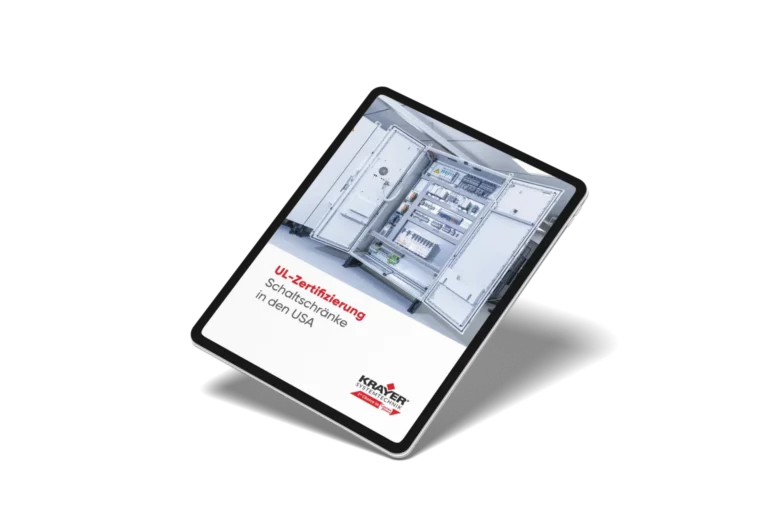
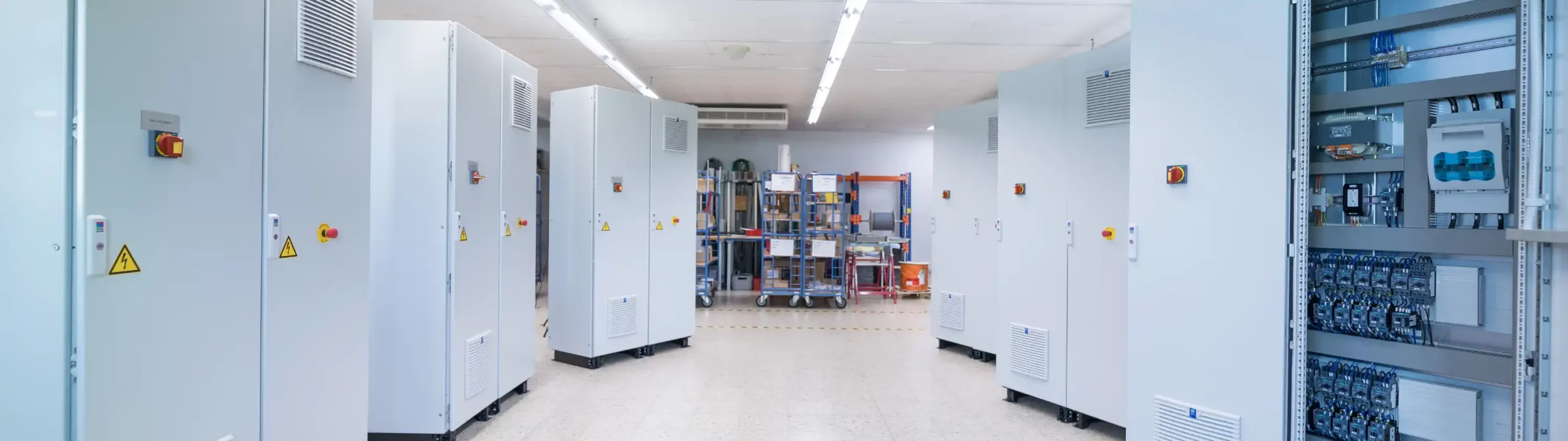
A control cabinet for the U.S. essentially serves the same purposes as its counterpart for the European market. It houses the electrical and electronic components that cannot or should not be installed in the system or machine itself. The main differences lie not in the functions of an American control cabinet, but in the safety requirements imposed on it and the testing procedures for those requirements.
Relation to UL
Switchgear and control cabinets for the U.S. should be designed and manufactured by an expert to ensure that all requirements—which are often hidden in the details—are met. This is the only way to ensure that the rest of the project proceeds smoothly in the U.S.
Requirements for Control Cabinets in the United States
The requirements for control cabinets in the U.S. differ, in some cases significantly, from those to which control cabinet manufacturers and their customers in Europe are accustomed. Of course, we can only provide a brief overview here of the differences that exporters most frequently notice when they first enter the North American market.

Fire Safety
In the United States, fire safety for electrical systems is considered far more important than in Europe. This is due to historical reasons: When the first electrical devices appeared, the fire hazard they posed was considered at least as great as the risk of accidents.
Interlock
While fire safety regulations in North America are stricter than in Europe, control cabinets there are often not required to be as touch-safe as they are here. Instead, a so-called interlock ensures that no cabinet door can be opened as long as the components inside are still energized.
Clearances and Creepage Distances
For control cabinets intended for the United States or Canada, it is essential to ensure compliance with the clearances and creepage distances, as these are closely inspected during on-site acceptance testing.
Protective components
There are also significant differences when it comes to protective components. A control cabinet intended for the U.S. not only requires more protective components to meet legal requirements, but some of these components are also larger than those typically used in Europe.
Electric Circuits
One safety measure that is completely unknown in the EU—and which also increases space requirements—is the separate routing of certain electrical circuits. For example, the feed-in cable must neither cross nor intersect the other electrical circuits.
What laws and standards govern the requirements for electrical control cabinets in the United States?
The requirements for a control cabinet intended for use in the United States are primarily derived from two sets of regulations. One is the National Electrical Code (NEC), which includes specifications for evaluating short-circuit withstand capability (see SCCR) and requirements related to explosion protection. In addition, the NFPA 79 standard from the National Fire Protection Association (NFPA) is particularly important, as it specifies, among other things, the requirements for design, wiring, grounding, and labeling.
Control Cabinets for the U.S. and UL 508A
In addition to these government standards, UL 508A should also be mentioned. This is not a government regulation, but rather an internal standard of Underwriters Laboratories (UL), a government-recognized, private testing institute. Unlike NFPA 79 and the NEC, the provisions of UL 508A do not apply to the entire system or machine, but only to the control cabinet.
Certification of a Switchgear System in Accordance with UL 508A
If a control cabinet is to be UL-certified, UL Standard 508A is always the governing standard. However, since this standard is based on legal requirements, it also ensures that the control cabinet meets the minimum legal requirements. This is indicated by a clearly visible UL label and is particularly important during the official acceptance inspection of the system at the installation site.
How does the acceptance process for control cabinets work in the U.S.?
Every control cabinet intended for connection to the power grid in the United States must be approved by the relevant authority prior to commissioning. This takes place as part of the approval process for the entire system or machine. The control cabinet is therefore not evaluated separately, but rather in accordance with its function at the site of operation.
Which authority (Authority Having Jurisdiction, AHJ) is responsible for inspecting the system varies from state to state. Individual states and even counties may also enact their own regulations, which, of course, must also be reviewed. A representative of the respective authority—commonly referred tosimply as an AHJ inspector—is responsible for the actual inspection. If the inspector identifies a defect, he or she will deny the operating permit, as the inspector would be liable for any resulting damage.
That’s why UL certification is helpful
This is where UL certification comes into play. It is not an “approval” or operating permit in the legal sense, but it gives the AHJ inspector the assurance that the control cabinet meets all legal requirements. That is why UL-compliant control cabinet construction with the corresponding label significantly facilitates the acceptance of the entire system by drastically reducing the testing effort. In addition, a control cabinet bearing a UL label generally receives the same level of acceptance as a CSA-certified control cabinet.
Zusammenfassung
Even though a control cabinet in the U.S. must perform the same functions as a product intended for the European market, the requirements are quite different. The approval process for the control cabinet by the relevant authorities also differs significantly from that in the EU. However, this process can be significantly simplified in the U.S. by using a control cabinet that is UL 508A-certified.

