




Certified manufacturers may affix the appropriate UL mark to their products if they comply with all specified guidelines and standards. Other terms are often used for this purpose, such as UL label, UL mark, UL certificates, or UL certification. There are various types of certification. The UL Listed mark is one of them and certifies that a stand-alone product has been manufactured in accordance with UL guidelines.
Relation to UL
The UL Listed mark is the most widely recognized certification from Underwriters Laboratories (UL). It officially confirms that a product has been tested by UL or a manufacturer recognized by UL and meets the specified safety standards.
What does “UL Listed” mean?
The UL Listed mark indicates that a product complies with applicable UL standards. It is the most commonly used UL certificate and applies only to stand-alone products. A UL Listed label can significantly simplify the approval process by the local building authority, as it is recognized in North America as a mark of quality and product safety.


What does the UL Listed mark stand for?
Like any UL label, the UL Listed mark certifies a product’s compliance with applicable safety standards. It therefore includes strict requirements regarding both user protection and the sustainability of the tested products. The testing required for a UL Listed label is therefore very comprehensive. A representative sample of the product is tested for potential risks of electric shock, fire, or mechanical hazards. All safety standards that the product under test must meet were developed by Underwriters Laboratories (UL) itself.
The UL Listed mark is the most commonly used UL certification and is applied to products such as household appliances, fire extinguishers, heaters, and smoke detectors. It is highly regarded, particularly among Americans, as a symbol of quality and product safety. For this reason, the UL Listing mark is also colloquially referred to as UL approval.
Is a product with the UL Listed mark automatically approved?
Even though a product is tested in accordance with UL’s product safety standards to obtain a UL Listed Label, this does not automatically mean it has been approved. In principle, a “UL Certification” never constitutes approval, but merely indicates that a product or component complies with applicable safety standards. Machinery and equipment bearing a UL Listing Label must therefore be inspected and approved by an inspector from the relevant Authority Having Jurisdiction (AHJ) prior to commissioning. However, the UL Listing Certificate greatly facilitates this approval process, as it is well-regarded and widely recognized. Thanks to the certification, the responsible AHJ inspector can rely on the product’s compliance with applicable regulations and will generally approve its commissioning without requiring extensive modifications. It is clear, however, that there are always exceptions, and just as UL certification is not an approval, it is also not a guarantee that a product will be accepted by the AHJ.

UL Listed – one of many certification marks
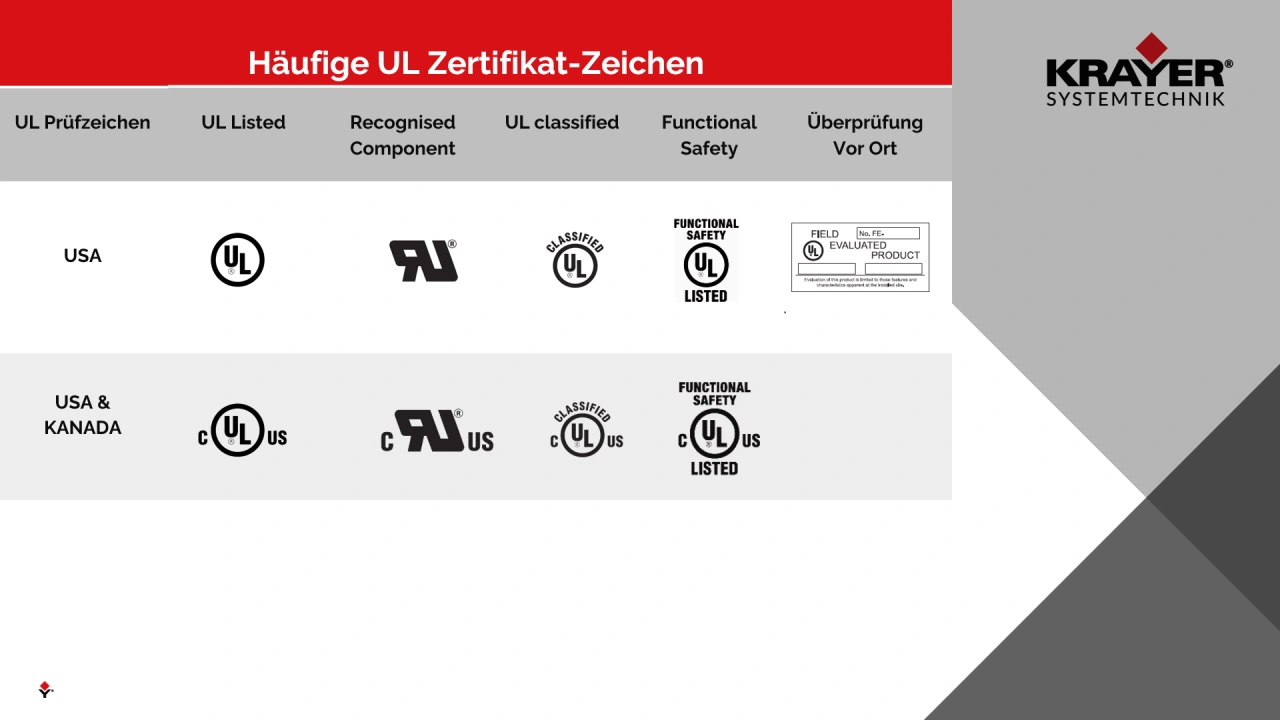
In addition to the UL Listed mark, there are many other UL certifications. These include the UL Recognized Component, UL Classified, and Functional Safety marks, as well as the Field Evaluation label. Each UL certificate represents different tests and their documentation. Along with the UL Listing, the UL Recognized label is one of UL’s most important certifications.
What is the difference between the “UL Listed” and “UL Recognized” labels?
The difference between a UL-listed product and the UL Recognized marks is that the Listed mark is always used for a complete product, whereas the Recognized mark is used exclusively for components, parts, or materials of a product. For example, switches, power supplies, or printed circuit boards often receive the UL Recognized Component label after successfully passing the testing process, whereas a finished control cabinet receives the UL Listed mark. Once components, parts, or materials have UL Recognized certification, they may be used in a UL-certified product under specified requirements without the product having to be retested. Consequently, however, the use of components without UL certification in a UL-certified product is only permitted in exceptional cases. For example, anyone wishing to use components without UL approval in a UL-certified control cabinet can check with the relevant local authority in advance to determine whether it permits the use of such components in a UL-certified control cabinet.
What is the difference between the “UL Listed” and “UL Classified” labels?
While products bearing the UL Listing mark generally have only minor requirements for use in the approved (application) areas, products with a UL Classified certificate may only be used under certain conditions. This is because they have been tested only for specific characteristics, a limited number of hazards, or suitability for use under restricted conditions. For example, the UL Classified label can be found on diving suits, industrial equipment, and fire doors, among other items.
Who is authorized to display the UL Listed mark?
Of course, UL itself tests and certifies products bearing the UL Listed mark, but the organization can also certify other testing laboratories or manufacturers, which are then authorized to use the UL mark. To be certified as a manufacturer authorized to use the UL mark, a company must pass a comprehensive inspection. For example, manufacturers of UL-certified control cabinets must, in addition to the standard “Producer” certification, employ a “Manufacturer’s Technical Representative (MTR)” at each manufacturing site for quality assurance purposes.
Zusammenfassung
UL Listed certification is often referred to as UL approval, as it confirms that a stand-alone product complies with applicable UL standards. During the extensive testing process, a representative product sample is tested for potential risks of electric shock, fire, and mechanical hazards. Although a product’s UL Listed certification does not mean that it is approved, this mark significantly facilitates approval by the AHJ. This is because, more than any other certification, the UL Listed label stands for quality and product safety in the United States. Only UL and UL-certified manufacturers and testing laboratories are permitted to affix the UL Listed certification to a product.

