




Relation to UL
The Canadian Standards Association, or CSA for short, is Canada’s testing and standards organization and thus the equivalent of UL.
Both testing organizations, UL and CSA, recognize each other’s certifications, so a UL-certified control cabinet can be put into service in Canada.
What does CSA stand for?
CSA stands for Canadian Standards Association. The CSA Group is an independent standards organization based in Canada that is dedicated to safety and environmental protection. Its responsibilities include both the development and testing of standards and the inspection and certification of certain products.
History of the CSA
The CSA was founded in 1919 as the Canadian Engineering Standards Association (CESA) and was tasked by the Government of Canada with improving the safety of Canadian infrastructure through the development of national standards. In addition to construction products such as railway bridges and wire ropes, and many other areas, electricity was already recognized as a distinct sector within the CESA’s scope of work at that time.
The first edition of the Canadian Electrical Code was published as early as 1927. To this day, this CE Code remains a vital component of Canada’s electrical safety system, protecting both installers and consumers. It is updated every three years to reflect the latest technological advances and other important developments. In this way, it aims to help maintain and improve safety despite ongoing technological advancements.
Another important step took place in 1940: CESA began testing and certifying electrical products intended for sale and installation in Canada. Shortly thereafter, in 1944, the Canadian Engineering Standards Association (CESA) was renamed the Canadian Standards Association (CSA) to reflect its expanding scope of activities.
In the years that followed, the organization grew and expanded into other countries. In 2012, all business units were consolidated under the name CSA Group. Today, CSA Group is a global organization that leads the way in Canada in research, development, and education regarding standards, thereby improving safety, health, and the environment in Canada.
Global Auditing and Certification
CSA Group has 40 offices in 14 countries and collaborates with laboratories and partner organizations in more than 30 countries. It draws on the expertise of over 1,600 in-house and 9,000 volunteer technical experts from around the world. It standardizes and tests in the following areas:
- Lifestyle and the Environment
- Environmental Technology
- Electricity and Electronics
- Communication and Information
- Construction
- Energy
- Transportation and Distribution
- Materials Engineering
- Sales and Production Management Systems
Why CSA?
CSA Standards govern the safety of electrical products in the Canadian provinces and territories. All electrical machinery and equipment connected to power sources must comply with CSA safety standards, regardless of type or quantity. Many of these standards have been officially adopted as Canadian national standards and are referenced in laws and regulations. As such, they have the force of law in Canada and are designated with the prefix “CAN.” For example, CAN/CSA-C22.2.
Does the CSA mark apply only to the Canadian market?
No, it is also recognized in the United States. The CSA Group and Underwriters Laboratories Inc. (UL), the leading testing and certification organization in the United States, have signed a mutual recognition agreement. As a result, tests, inspections, and certifications are mutually accepted as equivalent. Machinery and equipment manufacturers can freely choose between UL certification and CSA certification.
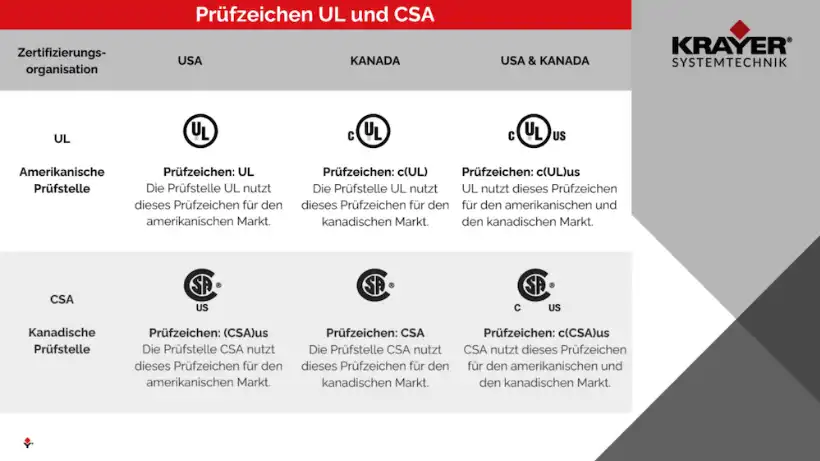
The certification marks vary depending on the certification organization and the market in which the machinery and equipment are put into service. The following table shows the different certification marks. Terms such as “listed” or “classified” are also used by UL.
Another important step took place in 1940: CESA began testing and certifying electrical products intended for sale and installation in Canada. Shortly thereafter, in 1944, the Canadian Engineering Standards Association (CESA) was renamed the Canadian Standards Association (CSA) to reflect its expanding scope of activities.
In the years that followed, the organization grew and expanded into other countries. In 2012, all business units were consolidated under the name CSA Group. Today, CSA Group is a global organization that leads the way in Canada in research, development, and education regarding standards, thereby improving safety, health, and the environment in Canada.
Important CCN Codes in UL Control Panel Construction
What does NITW stand for?
NITW is the CCN for UL 508A, the standard for industrial control cabinets and mounting panels used for general purposes in the United States. NITW refers to control cabinets in ordinary environments, known as Ordinary Locations (OrdLoc). These are all operating environments in the United States—excluding hazardous locations—that are approved in accordance with the National Electrical Code (NEC, NFPA 70).
The CCN NITW also applies to applications involving industrial machinery, air conditioning and refrigeration systems, crane and elevator control systems, flame control, as well as marine applications and service equipment.
As described above, the CCN for the Canadian market is NITW 7.
What does NRBX stand for?
NRBX is the CCN for the UL 698A standard. It applies to control cabinets that, while not used directly in potentially explosive atmospheres in the U.S., are directly connected to such areas. This area is also referred to as an Ex-i area. The control cabinet itself is located outside the “explosive atmospheres,” known as Hazardous Locations (HazLoc), and requires an intrinsically safe circuit extension, for which UL-listed barriers, for example, must be used.
Here, too, there is a specific CCN for the UL standards in Canada: NRBX 7.
What does NNNY mean?
NNNY is the CCN for the UL 1203 standard. This standard specifies the safety requirements for control panels intended for use in hazardous locations (HazLoc) in accordance with Articles 500–505 of the NEC, NFPA 70, which may be installed in Classes I, II, and III, Divisions 1 and 2; Class 1, Zones 0, 1, and 2; and Groups 1A, 1B, and 1C.
There are particularly strict technical requirements for these potentially explosive areas that must be met in order for electrical equipment to be classified as “explosion-proof” and “dust-explosion-proof.”
For example, when designing control cabinets, care must be taken to ensure that no arc-forming components are present and that the control cabinets can withstand elevated temperatures, as under no circumstances may a source of ignition be created or enter the hazardous area.
The CCN for UL standards in Canada is NNNY 7.
General Questions About UL/CSA
What is UL/CSA certification?
In the U.S. and Canada, electrical products require UL or CSA certification. The organizations UL (U.S.) and CSA (Canada) have developed standards that electrical products must comply with in order to be put into service in North America. Electrical devices designed and manufactured in Europe for the North American market should comply with these standards. UL and CSA certification can be obtained immediately upon completion, even before export.
The following standards apply to control cabinets and control systems:
For standard locations (OrdLoc)
UL 508A
CSA-C22.2 No. 14 and CSA-C22.2 No. 286
For Ex-i areas (HazLoc, potentially explosive atmospheres):
, UL 698A,
, CSA-C22.2 No. 157, CSA-C22.2 No. 213, CSA-C22.2 No. 60079-0 and No. 60079-11
For hazardous locations (HazLoc):
, UL 1203,
, CSA-C22.2 No. 25, CSA-C22.2 No. 30, and CSA-C22.2 No. 60079-28
The applicable standard is UL. Shouldn’t the certification mark be UL?
Since UL and CSA mutually recognize each other, the manufacturer is free to choose which standard to use for certifying the control system. Both certification marks are acceptable, even if the reference standard is UL.
The following standards apply to control cabinets and control systems:
For standard locations (OrdLoc)
UL 508A
CSA-C22.2 No. 14 and CSA-C22.2 No. 286
For Ex-i areas (HazLoc, potentially explosive atmospheres):
, UL 698A,
, CSA-C22.2 No. 157, CSA-C22.2 No. 213, CSA-C22.2 No. 60079-0 and No. 60079-11
For hazardous locations (HazLoc):
, UL 1203,
, CSA-C22.2 No. 25, CSA-C22.2 No. 30, and CSA-C22.2 No. 60079-28
What does “CSA-listed” mean, and when do electrical products require CSA or UL certification?
The CSA mark with the subscript letters “US” indicates that the CSA Group has tested and evaluated the product for compliance with the applicable American National Standard. The product receives this mark only if it meets the requirements of the National Fire Protection Association (NFPA) Standard NFPA 70 and the National Electrical Code (NEC).
All electrical products must have CSA or UL certification if they are intended for the North American market—that is, the United States or Canada. For more information, see the article “UL Standards and Product Liability in the U.S. and Canada.”
What is the difference between the UL, CE, EMC, FCC, and CSA marks?
UL and CSA are safety certification marks for product approval in North America, while the CE mark confirms that health, safety, and environmental requirements in Europe have been met.
EMC (Electromagnetic Compatibility) refers to Directive 2014/30/EU on electromagnetic compatibility, also known as the EMC Directive. It regulates electromagnetic compatibility for nearly all electrical devices in the European Single Market
The FCC is the Federal Communications Commission, an independent U.S. government agency that regulates broadcasting, satellite, and cable communications in the United States.
Image credit: sezerozger/ 123rf.com
Zusammenfassung
The Canadian Standards Association (CSA) is a testing and standards organization and the counterpart to UL. The CSA also develops standards, tests products, and subsequently certifies them. The Canadian Electrical Code (CE Code) was first published in 1927 and, in its updated form, remains the authoritative standard for electrical safety in Canada to this day. With 40 branches in 14 countries, the CSA tests products across a wide range of sectors, including the environment, construction, energy, and electronics. Since UL and CSA mutually recognize each other’s certifications, products bearing the UL mark and those bearing the CSA mark are recognized in the U.S. and Canada, respectively.

