




When it comes to exporting switchgear to North America, it is essential to pay close attention to the wiring and the wiring colors in the control cabinet. Not only does the safety of the system depend on this, but so does the success of the export. This is because the system will not be approved unless it meets all necessary UL standards.
Relation to UL
To be eligible for UL certification, the wiring and the entire switchgear must meet strict safety standards, and the specified wiring colors must be followed . By complying with UL guidelines, manufacturers can not only guarantee the safety and reliability of their products but also gain the trust of international customers and markets.
Basics of Control Cabinet Wiring
Control cabinets are always designed specifically to meet the requirements of the respective system or machine. Regardless of the control cabinet’s application or country of use, certain principles must be observed to ensure safety, functionality, and efficiency. This means ensuring that all components used—such as cables, connectors, and protective devices—comply with the relevant quality and safety standards. The cables must therefore be properly sized to handle the expected load without overheating or voltage drop. To this end, sufficient ventilation and heat dissipation must be incorporated into the design of the control cabinet wiring to prevent the components inside the cabinet from overheating.
Labeling, Wire Colors, and Documentation
In addition, it is essential to ensure that the wiring in the control cabinet is arranged logically. To achieve this, cables and connections must be clearly labeled, and the wire colors for different conductor types must be consistently applied. Only in this way can the control cabinet wiring help prevent mix-ups and enable quick identification, which in turn facilitates maintenance and troubleshooting. It is also important to check that all electrical connections are tight and secure to prevent hazards and potential malfunctions caused by loose wiring. And last but not least, detailed documentation of all wiring work must be maintained to ensure transparency and traceability.
Standards for Control Cabinet Wiring
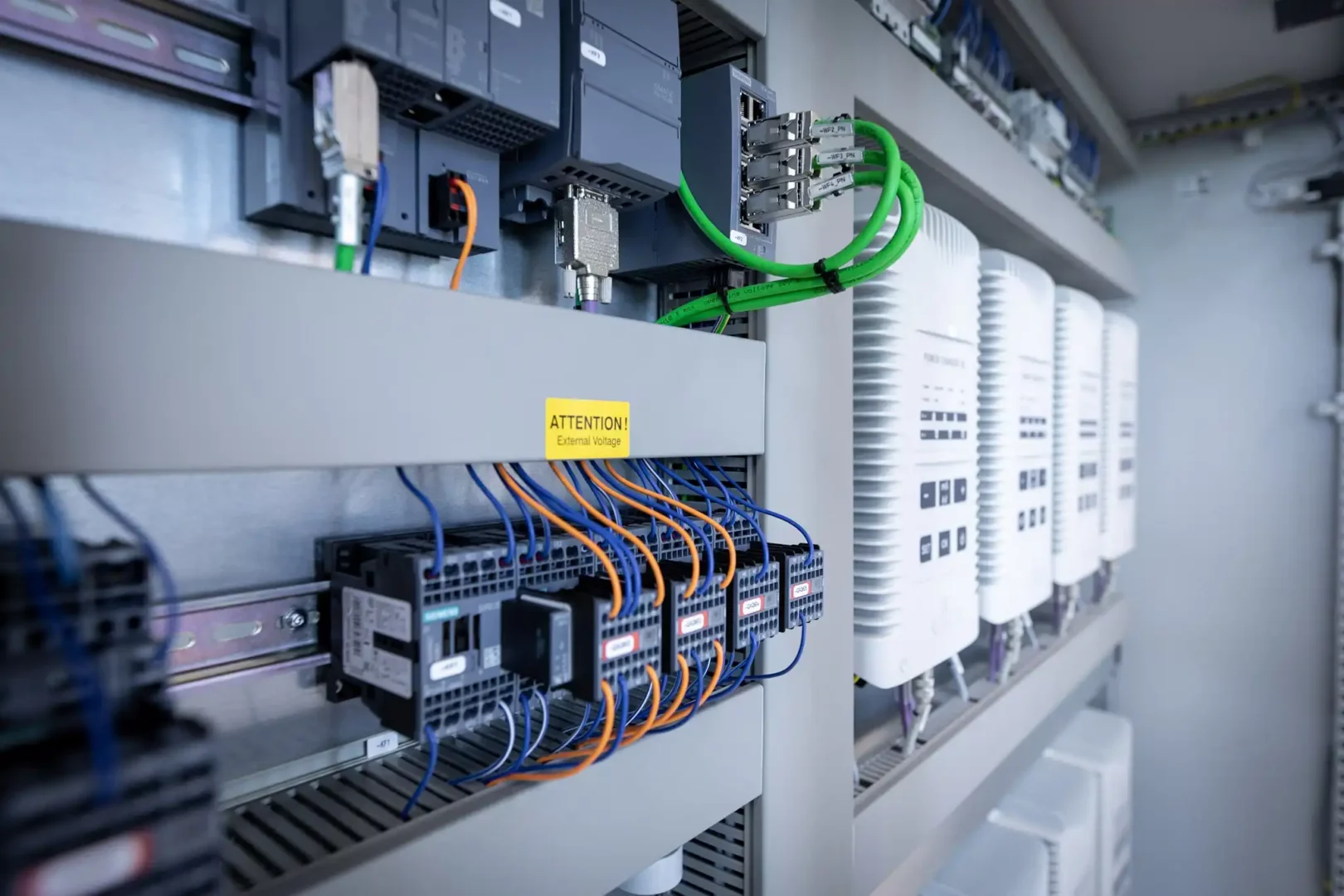
The various standards provide precise instructions for implementation, which may vary from country to country. For example, there are specific requirements for wiring a control cabinet for UL certification that differ significantly from the standard IEC standards. One of the biggest differences lies in the materials and components that are permitted: For a UL-compliant control cabinet, every single component—including all cables, connectors, and protective devices—must be approved by UL and UL-listed . However, there are several other special considerations that must not be overlooked.
The internal wiring in the UL control cabinet
When it comes to the internal wiring of UL-certified control cabinets, we must strictly adhere to the requirements of UL 508A. This standard defines clear guidelines for feeders and branch circuits, which form the basis for a safe and efficient electrical installation.
Minimum Requirements for Cable Size and Materials
A key aspect of UL 508A is the minimum requirements for wire size and the materials used. For most applications, a minimum wire size of 14 AWG (American Wire Gauge) must be ensured. This size ensures that the wires have sufficient current-carrying capacity and are not at risk of overheating. It is also crucial that all materials used are UL-certified. This means that not only the wires themselves, but also all connectors and protective devices must meet the high UL standards.
Current-Carrying Capacity and Circuit Sizing for Single and Multiple Loads
When sizing the wiring for individual loads, UL 508A specifies that the conductors must have a current-carrying capacity of at least 125% of the full-load current . This safety margin is crucial for ensuring safe operation even during potential peak loads. For control cabinets that supply multiple components, the requirements are more stringent. In these cases, the wiring must be sized to handle at least 125% of the total of all loads, including an additional 125% margin for the largest motor load. This careful planning ensures that the internal wiring can withstand all operating conditions and guarantees a reliable power supply within the control cabinet.
Clearances and Creepage Distances: Safety Considerations for Wiring in UL-Certified Control Cabinets
Another important aspect that must be considered when wiring UL-certified control cabinets is the clearance and creepage distances. These refer to the distance between different conductors or components, as well as the surface of an insulator over which an arc can travel before reaching another conductor. According to the requirements of UL 508A, these distances must be carefully considered to ensure the safety and reliability of the electrical installation. Compliance with the relevant clearance and insulation requirements minimizes the risk of arcing and thus potential hazards, which is essential for the safe operation of the control cabinet. This is one reason why UL-certified control cabinets tend to be larger.
Labeling and Identification of Wiring in Control Panel Construction
Proper labeling and identification of the wiring is also essential. Every wire in the control cabinet should be clearly labeled to prevent mix-ups and allow for quick identification. These labels should correspond to the information in the control panel’s schematic diagram . This not only facilitates commissioning but also simplifies future maintenance work.
Wiring colors in the control panel:
The wire colors in the control cabinet are critical for safety, maintenance, and compliance with standards—especially in UL-certified control cabinets. We’ll explain everything you need to know about wire colors, standards, and the key differences between UL- and IEC-certified control cabinets in this regard.
Why are wiring colors important in an electrical cabinet?
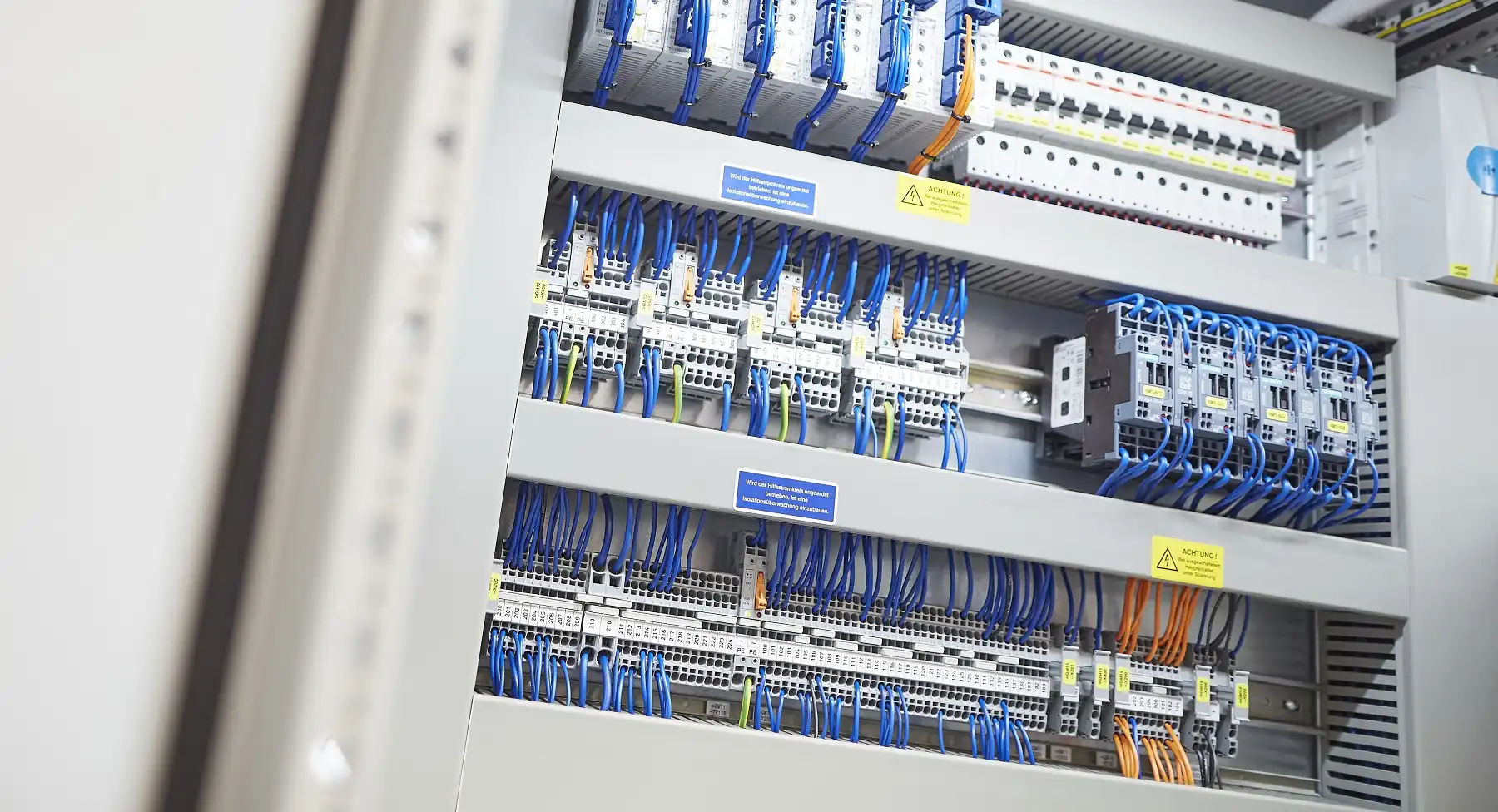
Color coding ensures that wiring is clearly identified, thereby minimizing errors during installation or maintenance. Correct wiring colors play a particularly important role in UL-certified control cabinets, as they are mandated by the UL standard. Incorrect or unclear color markings can not only lead to safety risks but also jeopardize UL certification.
Color Codes According to UL 508A: The Specifications in Detail
UL 508A defines clear requirements for the color coding of wires in control cabinets:
According to UL standards, specific colors are required for the wires in the control circuit:
- Black: For ungrounded main power lines carrying AC (alternating current) or DC (direct current).
- Red: Ungrounded AC control current
- Blue: Ungrounded DC control current line
- Green or green-yellow: Protective conductor to ensure safe grounding of the control cabinet
- Orange or yellow: Ungrounded control circuits or other wiring that remains energized when the main switch is turned off
- White, gray, or three white stripes: Grounded conductor of an AC mains circuit
- White with blue stripes: Grounded, direct-current control line
- White with orange or yellow stripes: Grounded AC control circuit that remains energized when the main switch is turned off.
The use of these color codes in the control cabinet not only simplifies installation and maintenance but also helps ensure compliance with UL standards, which is essential for the certification and export of switchgear to North America.
A Side Note on Europe: IEC Wiring and Recommendations for Wire Colors
Unlike the UL standard, the IEC standard sets less stringent requirements. DIN EN 60204-1 provides the following recommendations for wire colors:
- Black: Main circuits (AC/DC)
- Red: Control circuits (AC).
- Blue: Control circuits (DC).
- Orange: Locking circuits with an external power supply
These recommendations should be discussed individually with the customer and documented to avoid misunderstandings. It is particularly important to clearly agree on the wiring colors.
Frequently Asked Questions About Wiring Colors in Control Panels
What colors are required for protective conductors in a UL-certified control cabinet?
Protective conductors in UL-certified control cabinets must be green or green-yellow. This color combination may be used exclusively for protective conductors to prevent confusion and ensure safety.
What color is the control circuit?
According to UL specifications, ungrounded control circuits are color-coded in red (AC) and blue (DC). For grounded control circuits, color combinations such as white with red stripes (AC) or white with blue stripes (DC) are used. This color coding makes it easier to identify circuits and ensures faster troubleshooting.
What color is the control wire?
According to UL specifications, ungrounded control circuits are color-coded in red (AC) and blue (DC). For grounded control circuits, color combinations such as white with red stripes (AC) or white with blue stripes (DC) are used. This color coding makes it easier to identify circuits and ensures faster troubleshooting.
- Red: Ungrounded AC control power lines
- Blue: Ungrounded DC control power lines
- Grounded control wires may feature color combinations such as white with stripes (e.g., red, blue, orange). These color assignments minimize the risk of confusion.

External control cabinet wiring in the field
While we have so far focused on the internal wiring in the UL-certified control cabinet, external wiring in the field presents different challenges. This is because environmental conditions play a greater role in field wiring: External wiring is often exposed to harsher conditions, such as higher humidity levels or mechanical stress, and must therefore be designed to be more robust and meet specific protective requirements.
Requirements in accordance with UL 508A
UL 508A provides clear guidelines for field wiring in UL-certified control cabinets. The sizing of the conductors with regard to their current-carrying capacity is particularly important. They must be designed to handle not only the normal operating current but also potential overloads of at least 125% of the normal current. This requirement protects the wires from overheating and thus ensures the system’slongevity and reliability.
UL 1059 for wiring control panels
In addition to UL 508A, UL 1059 is also relevant. It defines the requirements for the use of terminal blocks in the field. It classifies different use groups , which vary depending on the application. For example, monitoring systems (Use Group A) require a greater creepage distance between terminals than general industrial applications (Use Group C). These specific requirements are crucial for ensuring electrical safety and functionality in various operating environments.
Protective and Safety Measures
Protective measures against environmental factors, such as moisture or chemicals, are also important. According to UL 508A, cables used in field wiring must be properly insulated and protected. This can be achieved through the use of cable trays or reinforced insulation. In addition, wiring techniques and proper installation in accordance with UL standards are essential to prevent malfunctions and hazards.
While we have so far focused on the internal wiring in the UL-certified control cabinet, the external wiring in the field presents different challenges. This is because environmental conditions play a greater role in field wiring: External wiring is often exposed to harsher conditions, such as higher humidity levels or mechanical stresses, and must therefore be designed to be more robust and meet specific protective requirements.
Wiring Outside the UL Control Cabinet: UL 2011 and NFPA 79
In addition, UL 2011 must be followed for wiring outside the control cabinet. It is based on NFPA 79, the electrical standard for industrial machinery and equipment. NFPA 79 establishes clear guidelines for the selection of cables, wires, and wiring methods to ensure that electrical connections are reliable and safe. In addition, protective measures against overloads and clear labeling of electrical components are required. These standards set forth specific requirements for preventing fires and electric shocks.
Zusammenfassung
The wiring in the UL-certified control cabinet is critical to the safety and regulatory compliance of electrical systems. By complying with UL standards, ensuring proper sizing, adhering to wire color codes, and performing correct installation, the reliability and safety of the switchgear can be guaranteed, which is essential for exporting to North America.


