




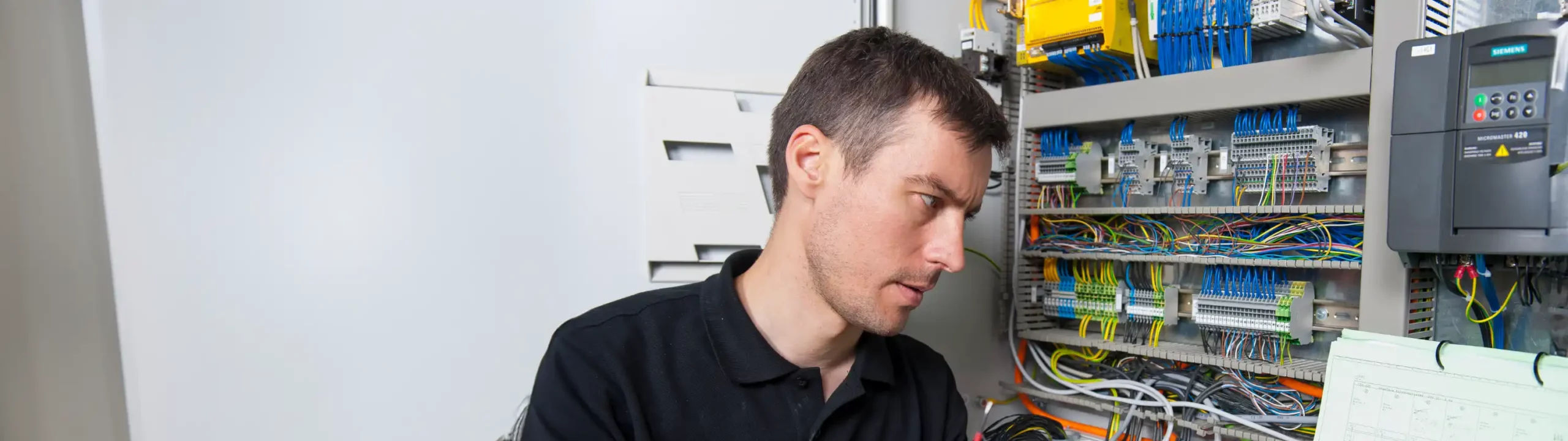
Field wiring refers to the wiring that connects electrical devices to one another or to the power supply at the point of use (in the “field”).
Relation to UL
Since field wiring depends on the operating environment, it should always be performed by well-trained qualified personnel.
Field Wiring or Factory Wiring: What’s the Difference?
In addition to field wiring—sometimes translated into German as “Feldverdrahtung”—there is also factory wiring. These two categories must be strictly distinguished from one another. In the following, we will examine the key differences between them.

Field Wiring
Field wiring involves connecting devices that are already in place at their location. For example, the cables running from a control cabinet to the system it controls constitute field wiring. Connecting devices to the power supply is also referred to as field wiring. This is generally not performed by the manufacturer, but by a company commissioned by the customer. According to UL 1059, only connectors or terminal blocks are used in field wiring.
Factory Wiring
Factory wiring, on the other hand, refers to the wiring performed by the manufacturer of the device in question during the production process. It therefore refers to the internal wiring of the product. In addition to plug-in and terminal block connections, other types of connections may also be used in factory wiring. For example, soldering is also permitted here, which plays a major role in practice, particularly with printed circuit boards.
What do these differences mean in practice?
In practice, the distinction between field and factory wiring is not just a matter of who is responsible for the wiring. This distinction is of the utmost importance even during the planning phase. Depending on whether the connection is field or factory wiring, different UL standardsapply. These, in turn, give rise to a whole series of design requirements, but the selection of components must also—at least in part—be guided by the distinction between these two categories.
Components or parts that are approved for use in control cabinets—for example, in accordance with UL 508A —may not be used for field wiring without further consideration, as connection technology must in some cases meet different requirements. For example, a pull-out test is mandatory for connectors used in field wiring, whereas this test is not required for similar components approved for internal wiring.
Which UL standard applies to field wiring?
The most important UL standard for field wiring is UL 1059 (“Terminal Blocks”). It specifies the requirements for the components used in field wiring and how they are to be installed. However, the standard does not provide uniform guidelines. Instead, a distinction is made between five so-called Use Groups (A–E). Use Group A (“Service”), for example, includes the external wiring of monitoring systems and operator consoles, while Use Group C (“Industrial, general”) refers to industrial applications of all kinds.
Clearances and Creepage Distances in the Wiring of Electrical Systems
Use Groups are particularly important when it comes to ensuring compliance with the required clearances and creepage distances between the individual terminals on a terminal block. However, users who wish to determine the correct safety clearances for the field wiring of their devices and systems must consider not only the Use Group but also the respective current rating. UL 1059 contains detailed tables for this purpose, but our discussion will be limited to a concrete example.
For voltages between 301 and 600 V, a creepage distance of at least 31.8 mm must be maintained between individual terminals for components in Use Group A, whereas 12.7 mm is sufficient for Use Group C.
Critical for intrinsic safety: Follow the wiring diagram
Components that are part of an intrinsically safe installation must be installed exactly as specified in the wiring diagram, because intrinsic safety relies largely on design features, not just on the selection of individual components. The minimum clearances mentioned above play a role here, as do many other factors that must be taken into account when designing a control cabinet.
A disconnect switch is used to interrupt the flow of electricity in a specific area. This may be necessary in an emergency, but is especially important during maintenance and repair work. When the disconnect switch in the control cabinet is set to “Off,” this ensures that the machine or parts of the machine are no longer supplied with power and that there is no longer any danger to personnel.
Zusammenfassung
Field wiring refers to the wiring that connects an electrical system or device at its point of use to other devices or to the power supply. It should be distinguished from factory wiring, which refers to the internal wiring of the product as performed by the manufacturer. UL Standard 1059 always applies to field wiring components.

