




Relation to UL
In control technology, UL certification is important for control systems, such as those found in control cabinets. Standards such as UL 508A specify how these systems must be safely constructed and wired. This ensures that control systems meet the applicable safety requirements.
What is control engineering?
Control engineering is a subfield of automation engineering and deals with the targeted control of processes in machines, plants, and technical systems in order to achieve a desired state or behavior. The goal is to execute processes efficiently, safely, and reproducibly.

What types of control systems are there?
In control engineering, a distinction is made between three types of control systems, whose applications and techniques can be used for different purposes.
- Binary controllers use binary signals and have only two states: on/off or 0/1,
- Analog controls are continuous and can take on any value within a range, such as voltage or temperature,
- Digital signals consist of discrete values (usually encoded in binary) and are used in modern, complex control systems for precise, high-speed data processing.
The Difference Between Regulation and Control Technology
The key difference between control technology and regulation technology lies in feedback: While control operates according to a fixed sequence without feedback, regulation responds dynamically to changes. In control engineering, the controlled variable is continuously measured and compared to the setpoint to automatically compensate for deviations. In control technology, on the other hand, there is no monitoring of the actual state—the process runs once or is time-controlled.
Control Technology – Explained Simply
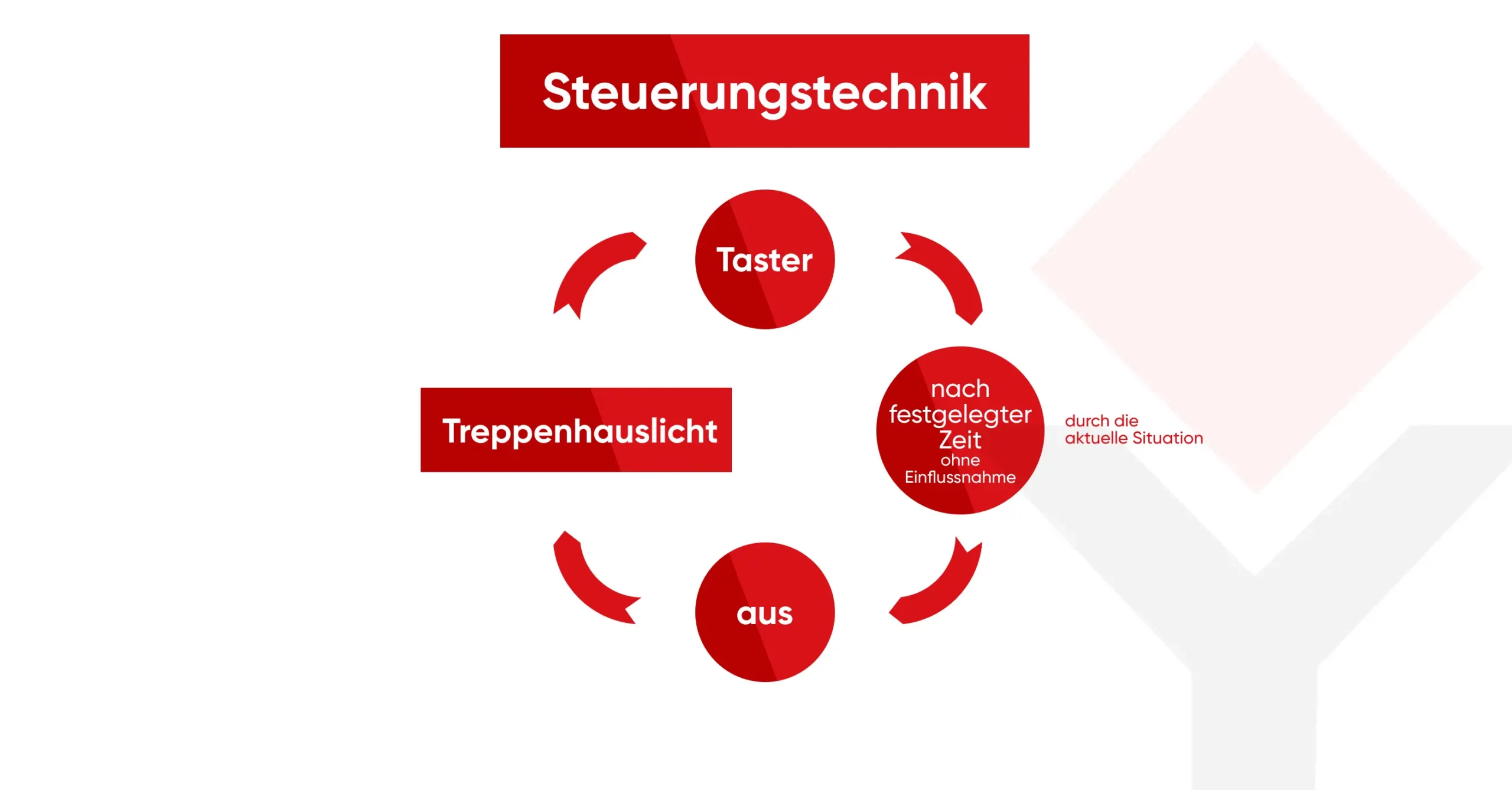
A classic example of control technology is the stairwell light: When the switch is pressed, the light turns on for a set period of time and then automatically turns off again—regardless of whether anyone is still in the stairwell. The sequence follows fixed specifications without feedback or readjustment. This is precisely what characterizes control technology: a strictly defined sequence of actions triggered by an input signal, without being influenced by the current situation.
Drive Systems as the Basis for Control Systems
Drive systems, also known as actuators, are devices or systems that, as the name suggests, generate drive and convert this force into specific movements. Actuators can be classified into three different types depending on their area of application:
- Electric actuators: Convert electrical energy into mechanical force; for example, an electric motor
- Hydraulic actuators: Use fluid pressure to generate high forces and precisely execute smooth movements even under heavy loads, e.g., forming machines in metalworking
- Pneumatic cylinders: Use compressed air to generate linear or rotary motion, such as gripper arms in the manufacturing industry

Drive and Control Technology
Control technology only works in conjunction with drive technology. It is only through the drive technology’s ability to execute mechanical movements with precision that a control system can carry out physical actions on the target system. Whether rotating, lifting, or conveying—the control system issues the commands, and the drive technology translates them into motion. In this way, it serves as the indispensable link between digital control commands and actual motion sequences in machines and systems.
What types of control systems are there?
While control engineering provides the theoretical foundations and principles of automated processes, control systems put these into practice. They consist of hardware and software components such as PLCs, relays, sensors, and control programs, and ensure that machines and systems operate precisely according to the specified control commands. Control systems thus serve as the link between planning and actual execution in an industrial setting.
Control cabinets, such as the UL 508A, UL 698A, or UL 1203, house these control systems—along with all their electrical components—in a safe and compact manner. They serve as the control center where all control units are interconnected, enabling such efficient implementation of control processes.

Programmable Logic Controller (PLC)
A PLC is a digital computer system used for the flexible automation of machines and systems. Unlike hard-wired control systems, the control sequence is programmed using software and stored in the PLC’s memory. It is a central element of modern control technology, as it can control logical sequences precisely and reliably—for example, in special-purpose machine construction, as well as in industry, building automation, and manufacturing.
PLCs – Explained Simply Using an Example
Let’s stick with the example of the stairwell light. Imagine there is a motion detector in a room that is connected to a PLC. When someone enters the room, the motion detector detects the movement and sends a signal to the PLC. The PLC then checks whether the light should be turned on (e.g., according to a predefined logic that the light turns on when motion is detected) and turns it on via a relay. When the room is empty and no more motion is detected, the PLC turns the light off again after a certain amount of time.
In this example, the PLC controls the light based on the input signals (motion) and ensures that the control commands are executed automatically.

Connection-Programmed Control (VPS)
VPS is a traditional, hard-wired control system in which logical sequences are defined by the physical connection of switching elements. Making changes is time-consuming because the wiring must be adjusted manually. For this reason, it is often replaced by PLCs today.
Computerized Numerical Control – (CNC)
CNC systems precisely control machine-specific motion sequences using digitally stored programs. They are typically used in machine tools such as milling machines or lathes and enable highly accurate, repeatable control.
RC – Robot Control
RC refers to the control of robots, typically in industrial manufacturing. This involves coordinating multiple axes of motion, executing predetermined motion patterns, and integrating sensor technology—often based on complex control and regulation algorithms.
Applications of Control Technology
Control technology is used in numerous fields, ranging from industrial manufacturing and automation to everyday applications. Other areas of application include, among others:
- Industrial manufacturing (e.g., production lines)
- Automotive Industry (e.g., Vehicle Control)
- Energy supply (e.g., power plants)
- Building Systems (e.g., Heating, Ventilation, Air Conditioning)
- Household appliances (e.g., washing machines, refrigerators)
- Robotics (e.g., industrial robots)
- Medical devices (e.g., diagnostic devices)

Zusammenfassung
Control technology is a subfield of automation technology and deals with the precise control of machines and systems. It encompasses various control systems, such as PLCs, VPS, and CNC, which are used to automate processes. These systems enable the execution of complex tasks in fields such as industrial manufacturing, the automotive industry, and building services engineering. Control engineering often works closely with drive technology to execute mechanical movements with precision.

