



Whether controlling temperature, speed, or pressure conditions, control technology is a part of automation technology and ensures that processes remain stable. Sensors record measured values, controllers compare target and actual conditions, and automatically correct deviations.
In short: Control engineering is the brain of a plant. It keeps processes stable, efficient, and safe.
What is control engineering?
Control engineering is a branch of measurement, control, and regulation technology (MSR ). Its goal is to influence processes in such a way that a desired state (setpoint) is achieved and maintained. A control system operates automatically. It measures the current actual state, compares it with the setpoint, and adjusts the control variable accordingly. In this way, the system reacts autonomously to external influences or internal changes while remaining in equilibrium.

Control Panel Construction and Control Systems
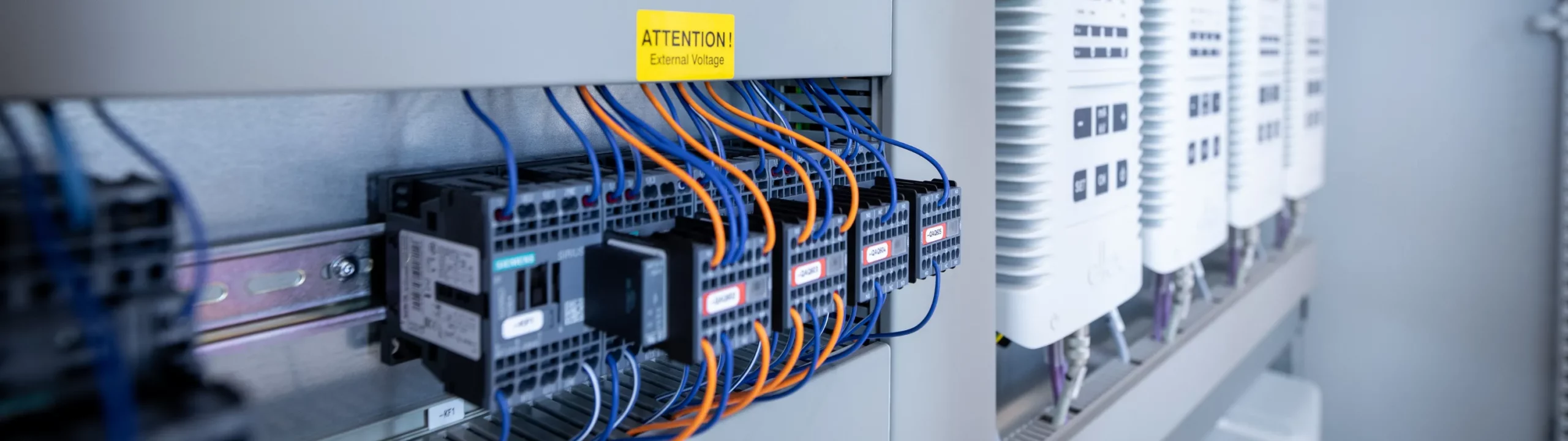
Control cabinets house the necessary components, such as sensors, actuators, control devices, and their wiring. Such solutions are standard practice, particularly in industrial automation—for example, for temperature control in systems or speed control in motors.

Key Parts and Components
At Krayer, we integrate control technology into the control cabinet design from the very beginning. Instead of simply supplying individual components, we develop complete control systems that are precisely tailored to the specific process.
These include:
- PLCs and control systems with precise process signals.
- Drive technology and inverters for speed-controlled motors, pumps, and fans.
- HMI and IPC components for operation, visualization, and process monitoring.
- Sensors and safety modules ensure that control loops operate reliably and safely.
- Network Technology and Communication: for example, using bus couplers, firewalls, and switches for data exchange between control components.
Combining these systems results in customized control solutions that precisely control machines and systems.
What is the difference between control engineering and automation technology?
Although the terms “control” and “regulation” are often used interchangeably in everyday language, there is a crucial difference between them. While control technology involves executing a fixed sequence without feedback—meaning the system does not react to current changes—regulation technology involves constant feedback. If the actual value and the setpoint differ, the system automatically intervenes to restore the desired state.
Real-World Example: Regulation and Control Explained Simply
A coffee maker that heats water based solely on time is considered a control system. If, on the other hand, the water temperature is continuously measured and adjusted, it is considered a regulation system.
What are some examples of control engineering?
Control engineering has a wide range of applications. Virtually no modern technical process can function without it:
- Temperature Control in Heating and Cooling Systems: PLC-controlled control loops maintain setpoint temperatures—a critical factor for process reliability and product quality.
- Motor Speed Control: Frequency converters precisely control the speed of motors, for example in pumps, conveyor belts, or mixing systems.
- Pressure Control in Pneumatic Systems: Sensor-Based Monitoring Ensures Consistent Operating Conditions.
- Power Control in Production Lines: Multiple control loops operate in parallel to regulate energy flows and prevent load peaks.
In short: Control engineering is used wherever conditions need to be stabilized automatically and reliably.

How the Control Loop Works
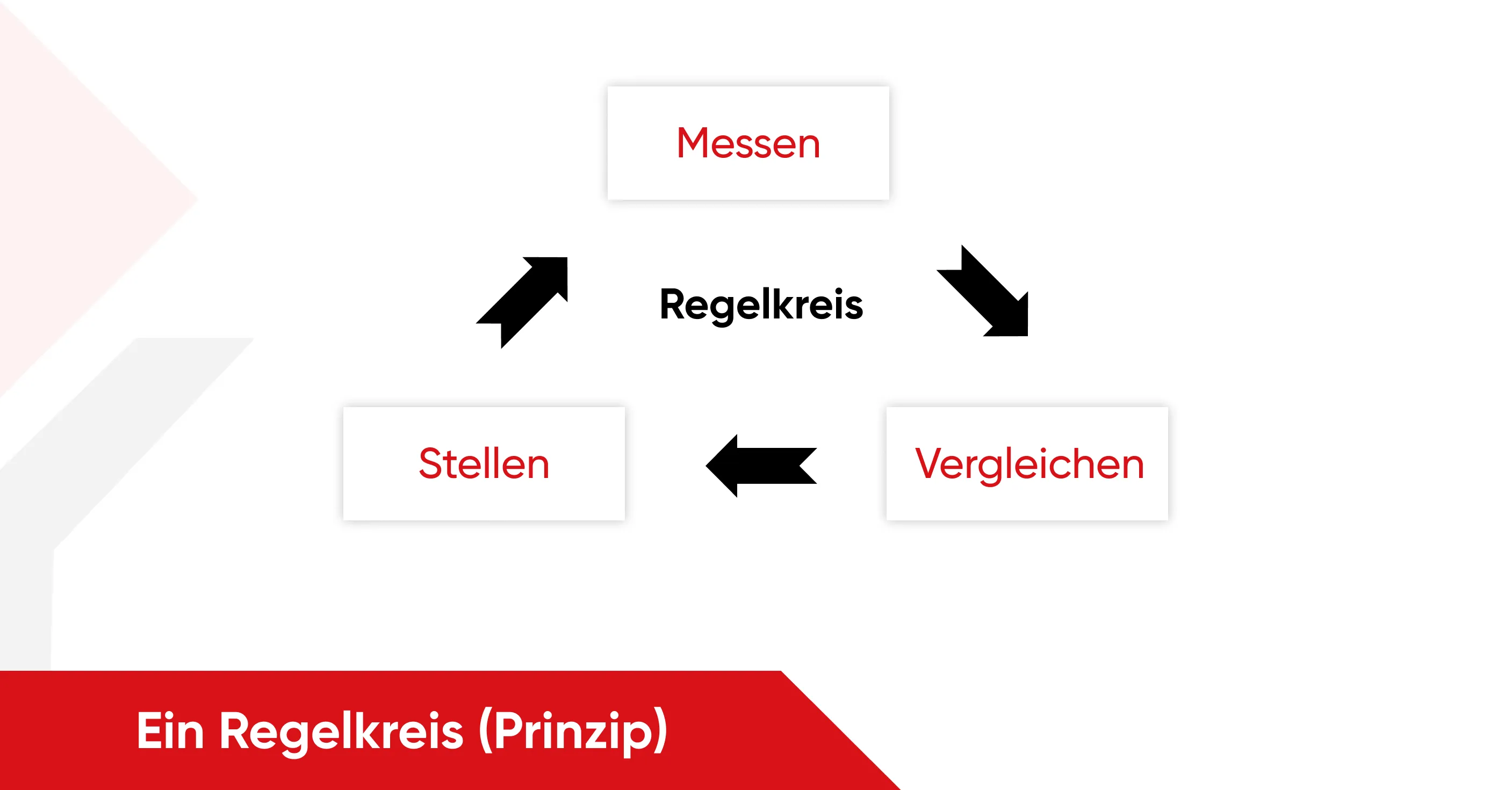
In what is known as a control loop, the current state of the system is continuously monitored, compared with the setpoint, and, if necessary, corrected via an actuator. This principle can be broken down into three consecutive steps: measurement, comparison, and control:
- The controlled variable is measured continuously or at intervals (usually using sensors).
- Its actual value is compared with the specified target value.
- If the actual value deviates, a control deviation is detected, and a suitable control variable is then calculated and applied to adjust the system state.
Types of Regulations
Depending on the process and requirements, different types of control systems are used. In addition to simple on/off controls (2-point controllers) and 3-point controllers, PID controllers are particularly common in industry:
- Proportional controller (P controller): Responds proportionally to the difference between the setpoint and the actual value. The greater the difference, the greater the correction.
- Integral controller (I-controller): It also tracks how long a deviation has persisted and compensates for it over time.
- Differential controller (D-controller): Evaluates the rate of change of the controlled variable and acts proactively to prevent overshoot.
These controllers are often combined (PID controllers) to maintain processes quickly, stably, and precisely. Such control systems also play a role in autonomous transport systems : They control speed, position, and motion sequences based on continuous comparisons of setpoint and actual values.
The Importance of UL Certification
UL certification plays a key role for products intended for the North American market. The UL 508A standard is particularly important for control cabinets containing control components. It specifies how electrical control systems, including control technology, must be safely designed and wired.
UL-Compliant Control Technology from the Experts
With over 30 years of experience in measurement and control technology, we at Krayer understand the requirements for reliable and safe control systems down to the last detail. We integrate control technology, control systems, and drive systems into a fully functional, integrated system that operates with precision and remains stable over the long term. Every control cabinet is custom-built to meet specific customer requirements, rather than following a standard design. The only standard is our certified quality. Through UL certification, we ensure that every solution can be used safely and in compliance with standards worldwide.
Zusammenfassung
Control engineering ensures that systems operate stably and reliably, even when external conditions are constantly changing. That is precisely what makes it so valuable: it helps us automate complex processes while making them safe and efficient. Especially in a world that is becoming increasingly interconnected and digital, control engineering continues to gain importance as the invisible yet crucial foundation of modern technology.

