




Potentially explosive areas exist wherever explosive substances such as flammable or combustible gases, vapors, or dusts are present. To ensure explosion protection and a high level of safety, EX zones must be properly labeled. In this article, we’ll explain exactly what that means and how a so-called explosive atmosphere forms.
Relation to UL
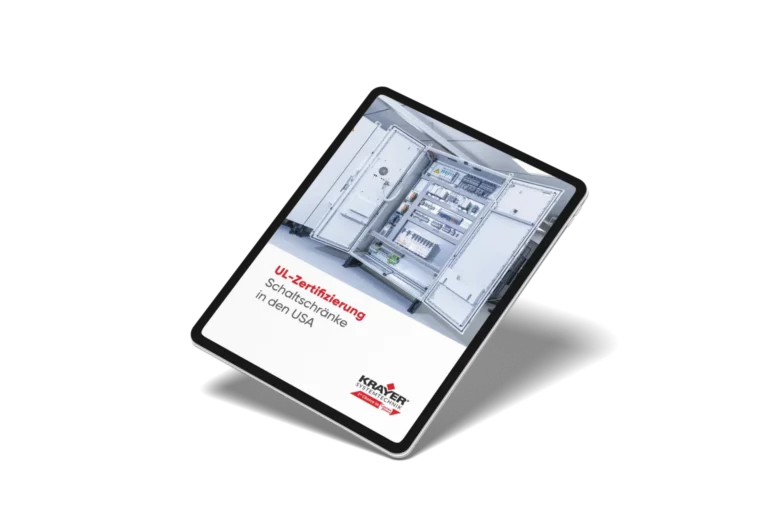
In the United States, control cabinets must meet very specific requirements in order to be operated in hazardous locations. The applicable standard is UL 1203.
How does an explosive mixture or an explosive atmosphere form?
An explosive atmosphere is a subset of explosive mixtures that occurs under the following atmospheric conditions: (-20 °C < T < 60 °C, 0.8 bar < p < 1.1 bar). Explosions occur when flammable or combustible substances are finely dispersed in the form of gases, vapors, mists (liquids), or dusts (solid particles) and are present within the explosive limits in the correct mixture ratio with air and with sufficient ignition energy. In short: flammable gas/dust + oxygen + ignition source = explosion. An effective ignition source must be present to trigger an explosion.

4 Conditions for the occurrence of explosions with dangerous consequences:
1. The concentration of flammable substances in the air is within the explosion limits
2. High degree of dispersion of the flammable substances (Gases and vapors naturally have a sufficient degree of dispersion)
3. A hazardous concentration of an explosive atmosphere
4. A sufficient ignition source
How are control cabinets in potentially explosive atmospheres protected against explosions?
As experts in UL certification for HazLoc (hazardous locations) in the U.S. and Canada, Krayer Systemtechnik’s control cabinets are certified with the UL 1203 label. The UL 1203 certification ensures that all strict technical requirements are met so that electrical systems are considered explosion-proof and dust-ignition-proof. Krayer Systemtechnik is a UL 1203 specialist for hazardous locations and, as a certified company, manufactures UL-compliant control systems and control cabinets in accordance with NNNY. The strict standards and guidelines of the U.S. and Canada are met in accordance with the UL standard, and commissioning proceeds smoothly.
What is an Ex Zone?
The abbreviation “Ex areas” stands for areas at risk of explosion. These are all areas where an explosive atmosphere may occur. This is the case wherever explosive substances, such as dusts or liquids, are present and there is a risk of explosion.
How are the “Ex” sections categorized?
Explosive areas are divided into three different zones : some for flammable or combustible dusts (Zones 20, 21, 22) and others for the presence of flammable or combustible gases, gases, and mists (Zones 0, 1, 2). In total, there are 6 different EX zones that must be distinguished. Below, we explain the meaning of the zone classification (ATEX zones):
Zone 0 / Zone 20
In this hazardous area, an explosive atmosphere is present continuously or frequently during normal operation. In the case of flammable dusts, this takes the form of a cloud.
Zone 1 / Zone 21
In this Ex zone, a hazardous explosive atmosphere may occasionally form during normal operation.
Zone 2 / Zone 22
In Ex Zone 2, a hazardous explosive atmosphere does not normally occur. If an explosion risk does arise, it is very rare and short-lived.
You can also find more information on this topic in our detailed article on Ex zones.
What do “frequently,” “occasionally,” and “briefly” mean?
When defining the various zones in the assessment of explosion hazards, the terms “frequent,” “occasional,” and “short-term” are used. Below, we explain the exact meaning of these terms:
Frequent: An atmosphere is considered to be frequently explosive if it exists for the majority of the time—that is, for more than 50% of the operating time.
Occasional: Explosive atmospheres occur only occasionally, at irregular intervals. In percentage terms, there is a risk of explosion during 1% to 10% of the operating time in the hazardous area (Zone 2). Examples of this include venting and sampling.
Short-term: If the risk of explosion lasts for a maximum of 30 minutes per year, it is referred to as short-term or temporary. Examples of such issues include flanges, connections, emergency pressure relief systems, and valves.
Zusammenfassung
Safety comes first
Explosions produce flames, high pressures, and high temperatures . They can ignite other flammable substances, injure people, and destroy equipment and buildings. Safety is therefore a top priority, especially in hazardous areas. If flammable substances are used in facilities, explosion protection requirements must be met, such as the classification into EX zones and the assessment and implementation of appropriate explosion protection measures. If a clear assessment of the explosion risk is not possible, the more dangerous scenario must always be assumed. As a specialist in control cabinets compliant with UL standards, Krayer Systemtechnik manufactures control cabinets that can also be used to meet the stringent requirements of EX zones. Certified to the UL 1203 standard for explosion-protected and dust-explosion-protected electrical equipment.


