




North America is an important growth market for German mechanical engineering companies, not least because of the new president’s economic policies. The headquarters of the largest companies in the automotive, electrical engineering, electronics, and consumer goods sectors are also located in the U.S. Furthermore, machinery and equipment bearing the “Made in Germany” quality label are highly valued there as well as in Canada. However, before your overseas customer can put the system into operation, there are several challenges you, as a German machinery manufacturer, must overcome.
Step 1: Clarifying the Technical Requirements
The first major hurdle lies in the requirements for control systems. The regulations in effect in the U.S. and Canada differ significantly from European standards in this regard. During a technical project meeting, we’ll discuss the options with you based on your product sample and highlight the adjustments needed to ensure safe export to the U.S. During this consultation on machine safety, we’ll take the applicable regulations into account and determine which standard applies to your control system. Depending on the environment in which the control cabinet and the machine are located at the customer’s site, different standards apply, as established by Underwriter Laboratories (UL), the leading testing laboratory in the U.S.: UL 508A is the standard for control systems intended for general use in all ordinary operating environments (OrdLoc – Ordinary Location), with the exception of hazardous locations. UL 698A applies to control systems that are not used directly in hazardous locations but have a direct connection to these hazardous areas (HazLoc – Hazardous Locations). This area is also referred to as an Ex-i zone. UL 1203 is the standard for explosion- and dust-explosion-protected electrical equipment intended for use in hazardous locations (HazLoc) that are precisely classified. This area is also referred to as an Ex zone.
Step 2: Manufacturing and Labeling Your Control System in Accordance with UL Standards
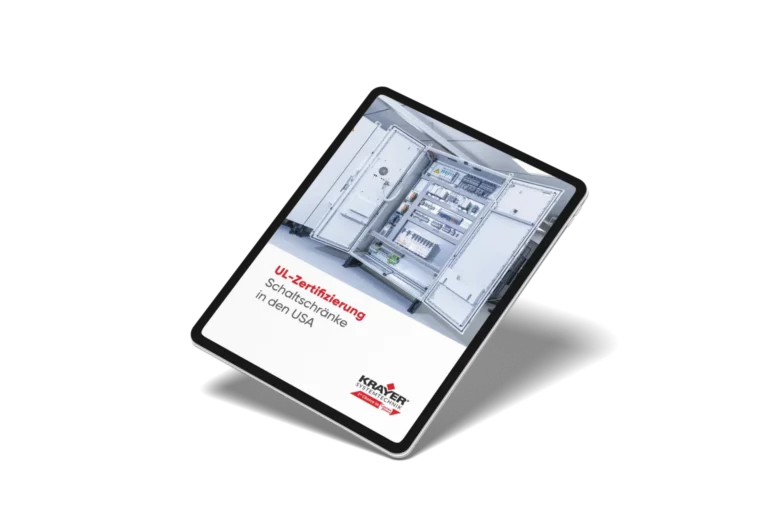
To ensure that your machine or system can be exported without any problems, the control system should already have UL certification in Germany. As an expert in UL-compliant control cabinet construction, KRAYER is authorized to perform this UL certification itself: we manufacture your control system in strict accordance with UL standards and certify it. We prepare the test documentation and the preliminary acceptance report. We then affix the UL label, which serves as official proof of compliance. For these UL-certified control systems, no further testing is generally required after export. Due to a cooperation agreement, these standards and UL certifications are also valid for Canada.

Step 3: Docking the UL Control System and Preparing for Transport
Once the UL control system is complete, we’ll prepare your system for export. We’ll connect the control system and handle the electrical wiring for the machine. Then we’ll install the software and perform a test run of the system. Once everything is ready and functioning properly, we’ll pack the system for overseas transport.
Step 4: Transportation and Commissioning
Together with our partners, we ensure that all customs formalities—including C-TPAT certification—are handled smoothly. Your equipment will arrive at its overseas installation site quickly and easily and will be put into operation there. When local inspectors from OSHA, the U.S. Occupational Safety and Health Administration, see on site that the UL label is affixed and the control system is already certified, no further inspection is usually required. This greatly reduces the risk that the system will not comply with applicable regulations and therefore cannot be installed or used. If necessary, we train the local staff, after which the entire export process is complete. The system can begin operating—and your overseas growth continues to advance.


