




Grounding a control panel is a complex process that requires compliance with a wide range of requirements. These requirements stem from both technical necessities and legal regulations, as well as applicable UL standards, as will be shown below.
Relation to UL
It is absolutely essential to perform grounding in accordance with standards in order to protect both people and the facility itself in the event of an emergency!
Why There Can Be No Such Thing as “Grounding”
Grounding a control cabinet is a challenge. Choosing the right method depends on many factors. On top of that, a wide range of regulations stemming from the applicable UL Standard 508A for control cabinets must be reconciled with the customer’s requirements. In short: The grounding of each control cabinet model is as unique as the cabinet itself. Therefore, only a general overview of the most common procedures can be provided here.


What types of grounding are used in control cabinets?
In English, a fundamental distinction is made between “earth grounding” and “equipment grounding.” Both are referred to as “erdung” in German; however, there are some significant differences that will be briefly examined here.
Earth Grounding
Earth grounding most closely corresponds to what is commonly understood as grounding. This form of grounding is primarily intended to protect the control cabinet from superimposed voltages, such as those that can result from lightning strikes or accidental contact with higher-voltage systems. In addition, this type of grounding prevents the control cabinet and its components from becoming statically charged. The well-known grounding rod is frequently used for earth grounding. This is a metal rod (usually made of steel or copper) with a diameter of 1–2 centimeters and a length of up to 3 meters, which diverts the current into the ground. The exact dimensions of the rod depend on the conductivity of the soil but should be selected so that the resistance between the grounding conductor and the ground does not exceed 25 ohms. The manufacturers of the grounding rods can usually provide helpful advice in this regard.
Equipment Grounding
Equipment grounding serves two purposes: First, it protects people from fatal electric shocks if they come into contact with the control cabinet. Second, improper grounding can cause components to operate at different reference voltages. These voltage differences can interfere with data transmission between components and, in extreme cases, lead to the collapse of the entire network. The nonprofit Electric Power Research Institute (EPRI) estimates that over 80 percent of all power-related malfunctions in electronic systems are caused by incorrect wiring or grounding.
Why Both Grounds Are Necessary
Both types of grounding thus serve different purposes, but can still only provide reliable protection when used together. How does this work? Let’s imagine a control cabinet in which earth grounding ensures a neutral potential in the main panel. Equipment grounding then serves to transfer this neutral potential to the enclosure and other parts of the control cabinet.
Grounding Components
In practice, three types of components are commonly used for grounding the control cabinet: in addition to the grounding rod —already familiar from earth grounding—these include the grounding terminal and the grounding lug for equipment grounding. No matter how many circuits or components in a control cabinet need to be grounded, or which components are used to do so, all grounding connections ultimately converge at a single point. There, they are connected to the grounding rod via the main grounding conductor. Typically, the conductor is routed into the control cabinet together with the power supply.
Grounding Terminal
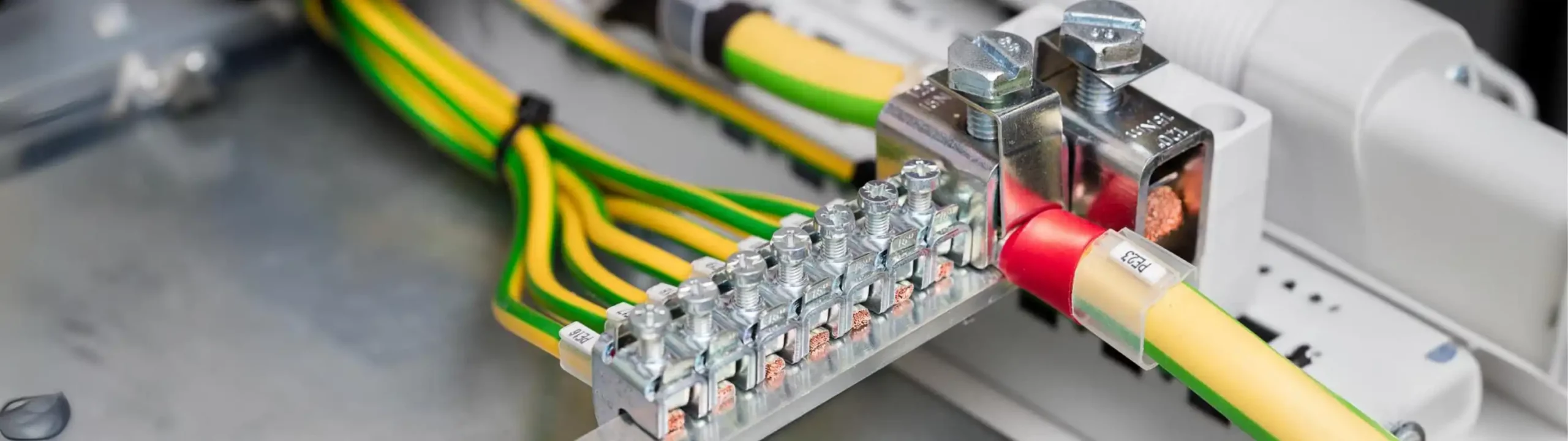
The grounding terminal is used to ground the individual circuits. To this end, it is mounted along with other components on the metal DIN rail, which serves as a conductor.
Grounding lug
The grounding lug serves the same purpose as the terminal; however, it is used to screw the grounding cable to the housing, which in turn is grounded via the grounding rod.
What are the requirements for grounding a control cabinet?
The National Electrical Code requires that a grounding system be permanently in place and have sufficient capacity combined with low enough resistance to safely dissipate any fault current that can realistically be expected. Furthermore, the ground should not be the only conductor. UL 508A implements these requirements in a UL standard for the construction of control panels.
Structure
More important to the end customer than the technical specifications of the UL standard is the following: A UL-certified control cabinet is always delivered with the appropriate documentation indicating the correct grounding configuration. These instructions must be strictly followed, and only the supplied cables, terminals, etc., may be used, as this is the only way to ensure the necessary protection. Furthermore, care must be taken to ensure that any labels supplied for identifying the grounding conductors are affixed correctly, as labeling is also a component of UL certification.
UL 467: Everything You Need to Know About the Right Components for Grounding
In addition to UL 508A, which addresses the specific safety requirements for control cabinets used in industrial applications, UL 467, “Grounding and Bonding Equipment,” is relevant to our discussion. This standard specifies the general requirements for components used for grounding.
Zusammenfassung
Grounding in a control panel is a complex but extremely important matter that is crucial not only for the safety of the control panel itself but also for the safety of the operators. In addition to operational requirements and technical necessities, the relevant legal regulations and UL standards (UL 467, UL 508A) must also be observed.

