



The ATEX Directives are designed to improve explosion protection in industrial environments where hazardous substances such as gases, vapors, or dusts are handled. The goal is to protect people and equipment from explosions and their resulting consequences.
Relation to UL
Various operating guidelines around the world govern safety standards for potentially explosive atmospheres. ATEX is required by law for use in Ex zones throughout the European Union, while UL (Underwriters Laboratories) sets requirements in accordance with the National Electrical Code (NEC) for the U.S. market. Manufacturers often seek dual certification to meet both EU and U.S. requirements.
What is ATEX?
ATEX is a European directive that establishes requirements for equipment, machinery, and protective systems intended for use in potentially explosive atmospheres. Under this directive, equipment receives ATEX certification to ensure it is safe for use in these areas.
The term is an abbreviation derived from French, standing for“ATmosphères EXplosibles, ”and establishes safety standards to prevent risks posed by explosive atmospheres, such as those that can occur in industrial environments. This is ensured through technical measures, zone classifications, and certifications.

Explosion Protection in Accordance with the ATEX Directive
In many work environments, gases, dust, or vapors can be present in the air. If these substances ignite, explosions can occur that endanger both people and equipment. Activities such as painting vehicles, chemical production, sawing wood, or grinding grain are among the processes in which explosive atmospheres can form. The goal is to prevent explosions or minimize their effects as much as possible. Safety in potentially explosive areas is therefore governed by various guidelines.
The two relevant operating guidelines covered by ATEX are:
- ATEX Product Directive 2014/34/EU —sets forth the requirements for equipment and protective systems intended for use in potentially explosive atmospheres and is mandatory for product safety. The protection of people, such as equipment users, is a top priority.
- ATEX Directive 1999/92/EC – establishes safety requirements for workplaces located in potentially explosive atmospheres.
The ATEX Directives were introduced in 1994 as Directive 94/9/EC and were adapted to the New Legislative Framework (NLF) in order to promote the free movement of goods within the internal market and to harmonize national regulations.
Differences in Operating Policies

ATEX Marking of Equipment
All products, machines, equipment, protective systems, and devices used in potentially explosive atmospheres must be marked in accordance with the ATEX Directive 2014/34/EU. An EU Declaration of Conformity is also required. The following marking must be affixed to the devices:
- Manufacturer’s Name and Address
- CE Marking
- Identification number of the participating testing laboratory (if available)
- Series and Model Designation
- Serial or manufacturing number
- Year of manufacture
- Specification of the device group and device category
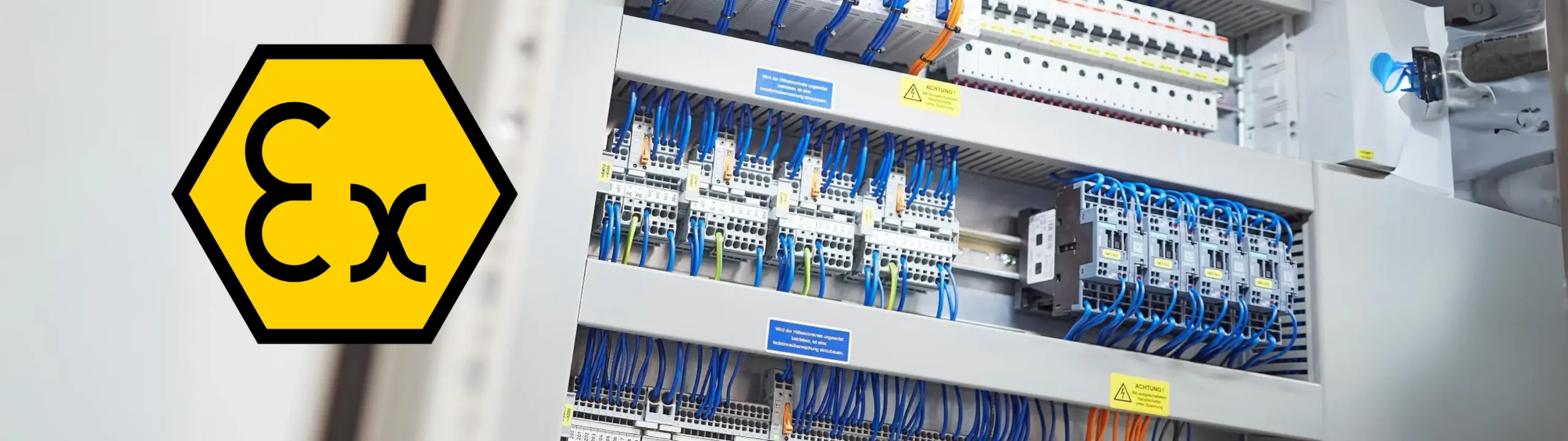
The “Ex” symbol indicates that the device is ATEX-certified, and the ATEX marking specifies the areas for which a device is suitable. It contains important information, such as the device group, the device category, the ATEX zone, the temperature class, and the type of protection.

ATEX Certification
ATEX certification is a key component of safety technology in potentially explosive atmospheres. It ensures that equipment and protective systems comply with the requirements of the ATEX Directive and can be used safely in hazardous environments.
Which devices require ATEX certification?
As a general rule, all equipment and systems that either act as potential ignition sources themselves or are used in potentially explosive atmospheres require ATEX certification. This primarily applies to sectors and industries that handle flammable or explosive substances, such as the chemical, oil and gas, food production, and pharmaceutical industries.
Not only electrical equipment such as control cabinets must be ATEX-certified, but also mechanical parts, protective systems, and components that are installed or operated in the hazardous area. Control and regulation technology designed for safe operation in ATEX zones is also subject to this requirement.
Here’s How the ATEX Certification Process Works
To obtain ATEX certification, equipment and protective systems must undergo a rigorous testing and certification process. This process includes the following steps:
- Step 1 – Risk Assessment and Ignition Source Analysis: Manufacturers must demonstrate that their products can eliminate potential ignition sources, such as sparks, overheating, or electrostatic charging.
- Step 2 – Testing by a Notified Body: An independent testing body conducts detailed tests and analyses. In Europe, these bodies are accredited by the relevant authorities.
- Step 3 – Technical Documentation: The manufacturer must prepare comprehensive technical documentation that includes information on the design, testing, and safe use of the device.
- Step 4 – Declaration of Conformity: After a successful inspection, the manufacturer issues a declaration of conformity certifying compliance with the ATEX Directive.
- Step 5 – Product Marking: The device is marked with an ATEX label that clearly indicates its suitability for specific hazardous areas and its safety features.

The Classification of Explosive Areas
To better assess risks and ensure the use of appropriate equipment, the ATEX Directive establishes clear classifications for potentially explosive atmospheres: the explosion group and category of the equipment, as well as the zone classification.
Explosion Group and Category
The classification into equipment groups and categories specifies the areas and hazards for which equipment must be designed:
- ATEX Explosion Group I: Equipment intended for use in mines where methane gas or combustible dust may be present.
- ATEX Explosion Group II: Equipment for other industries, such as the chemical, oil and gas, food production, and pharmaceutical industries. This group is further subdivided into categories.
In addition, equipment is classified into categories that take into account the frequency and duration of the presence of an explosive atmosphere. ATEX Explosion Group I comprises Categories 1 and 2, while Explosion Group II includes Categories 1, 2, and 3. Category 1 equipment offers a particularly high level of safety, while Category 3 equipment is designed for applications with normal safety requirements.

Zone Classification: What Are the Different ATEX Zones?
Under the EU’s explosion protection regulations, in addition to classification by category, a zoning system is also used, which is based on the frequency and duration of explosive atmospheres.

ATEX Zone 0 (gas) or 20 (dust)
Zone 0 and Zone 20 refer to areas where an explosive atmosphere is present continuously or for extended periods of time. Examples include pipes containing liquid solvents or areas where explosive dust clouds frequently form.
ATEX Zone 1 (gas) or 21 (dust)
Zone 1 and Zone 21 include areas where an explosive atmosphere may occasionally occur under normal operating conditions. A typical example is the extraction of gases.
ATEX Zone 2 (gas) or 22 (dust)
Zone 2 and Zone 22 designate areas where an explosive atmosphere may occur only rarely and for only a short time. An example of this is the clean gas area after extraction.
UL 1203 and ATEX: Explosion Protection for Control Cabinets
The ATEX Directive is of central importance for control panel construction, as it helps ensure that electrical systems operate safely and reliably in potentially explosive atmospheres. Control cabinet manufacturers must familiarize themselves with the requirements of the ATEX Directive and ensure that the components and systems they install meet the necessary safety standards in Europe to prevent the risk of explosions. The U.S. has followed the EU’s example and duly amended its NEC.

The U.S. is aligning itself with EU directives
With the introduction of NEC 505, the United States aligned itself with the ATEX Directive and established a second system that—as in Europe—classifies potentially explosive atmospheres based on the frequency and duration of the explosion hazard. However, this distinction is irrelevant for the requirements applicable to control cabinets, as the strict specifications of UL 1203 apply in this case.
Zusammenfassung
ATEX (ATmosphères EXplosibles) is a European directive that establishes safety requirements for equipment and protective systems in potentially explosive atmospheres. It covers the classification of hazardous areas into zones based on the frequency and duration of explosive atmospheres, as well as the classification of equipment into groups and categories. Equipment must be ATEX-certified when used in such areas to prevent ignition sources and ensure safety.

